Scientific teams working separately in Vienna and Beijing have developed the world’s first two operating nuclear clocks in what they are calling an important advance in timekeeping that promises wide-ranging practical applications and offers a new tool to investigate fundamental physics.
The two devices represent the next generation of atomic clocks, the ultra-accurate timekeeping machines first created in 1949. The two research teams, describing their achievements on Wednesday in scientific papers published in the journal Nature, said nuclear clocks have the potential to outperform the best conventional atomic clocks, but do not do so yet.
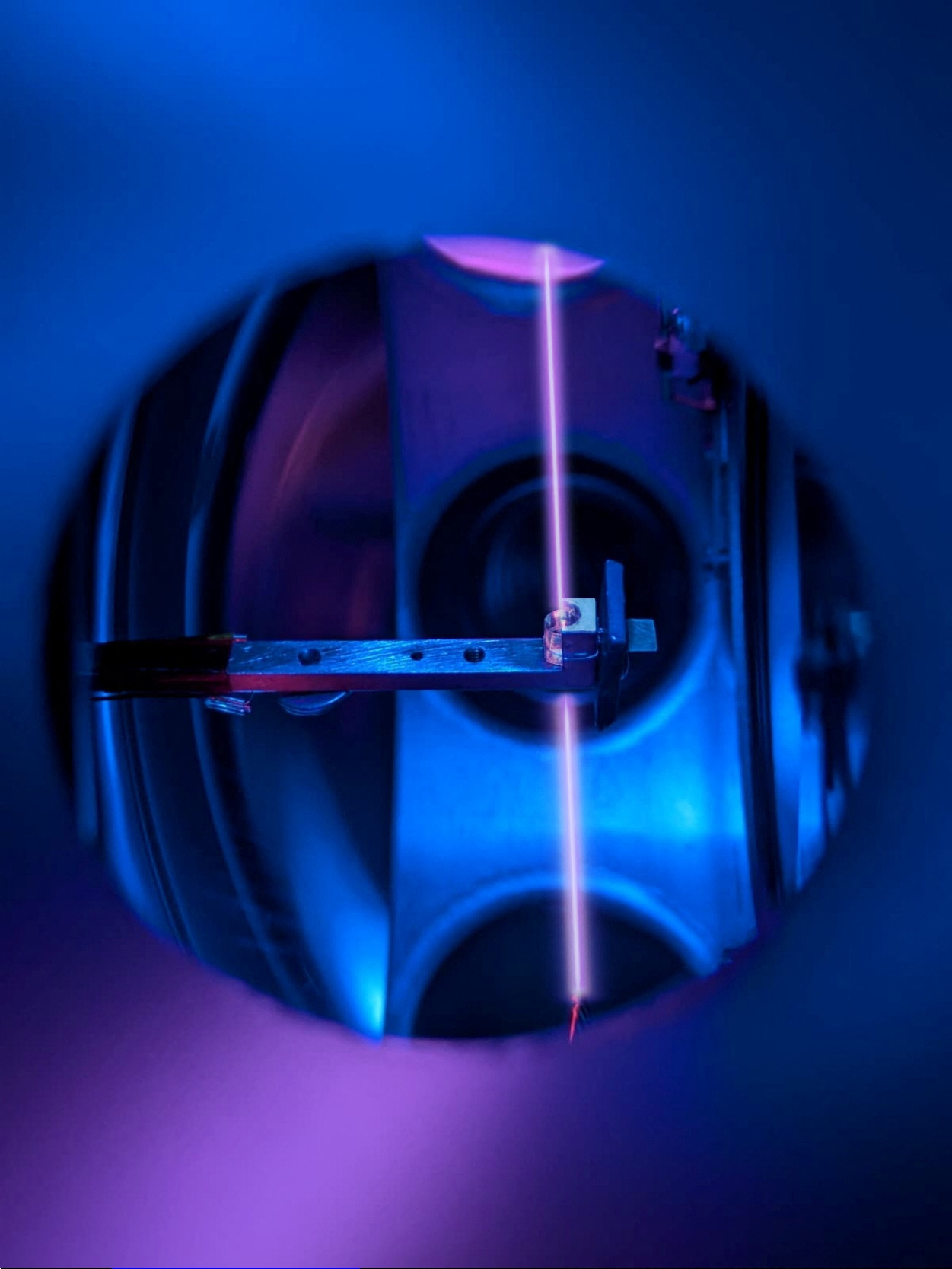
They are called nuclear clocks not because they are powered by nuclear fusion or fission, as a layman might surmise, but because time is calculated by monitoring how light — a high-powered laser — interacts with the nucleus of an atom. The nuclear clocks both are based on a form, or isotope, of the element thorium, called thorium-229, trapped in solid-state calcium fluoride crystals.
“The two teams worked independently and reached operating thorium-229 nuclear clocks at the same time, using different experimental approaches. I think this is very encouraging because it shows that the concept is robust and not dependent on one particular technical implementation,” said physicist Shiqian Ding of Tsinghua University in China, who helped lead the team behind the Beijing clock.
“The creation of a nuclear clock was something that physicists dreamt of for almost 50 years. In my team, we have been working towards this goal since 2008,” said physicist Thorsten Schumm of TU Wien in Austria, who helped lead the team behind the Vienna clock.
Schumm said he envisions uses for nuclear clocks in areas such as satellite-based navigation, synchronization of data transfer, surveying and metrology, which is the study of measurement and its practical applications.
Conventional atomic clocks measure time by using lasers or microwaves to make subatomic particles called electrons jump back and forth between two energy levels in an atom’s shell, using elements such as cesium or strontium. The new nuclear clocks measure time by using lasers to make subatomic particles called protons and neutrons jump back and forth between energy levels inside the nucleus of an atom, in this case thorium-229.
The idea is that tracking these transitions inside the atomic nucleus might attain even higher levels of accuracy than tracking them in electrons because an atomic nucleus is much smaller than the shell surrounding it where electrons reside.
PERFECTING THE TECHNOLOGY
Schumm said the nuclear clock is still “far from its target performance,” with the researchers looking to perfect the technology.
“What is really nice here: the Vienna clock has slightly better thorium crystals — higher concentration, better optical properties — while the Beijing team has a stronger laser. So already by putting these components together, we can build a significantly better clock,” Schumm said.
The best conventional atomic clocks can go billions of years losing or gaining only one second. This ultra-accuracy has been vital for applications such as global navigation satellite systems and internet, cellular and fiber-optic communications. The researchers think nuclear clocks, once perfected, may do the job even better and can be built to be less bulky and delicate.
The nuclear clocks offer promise in probing fundamental physics. The Vienna team demonstrated that their clock could carry out a precision physics experiment, as they sought to detect dark matter, a crucial component of the cosmos that to date has eluded observation. The experiment did not in fact detect dark matter but the nuclear clock performed at the level of the best atomic clocks.
“It gives access to a whole new physics universe,” Schumm said.
(Reporting by Will Dunham)