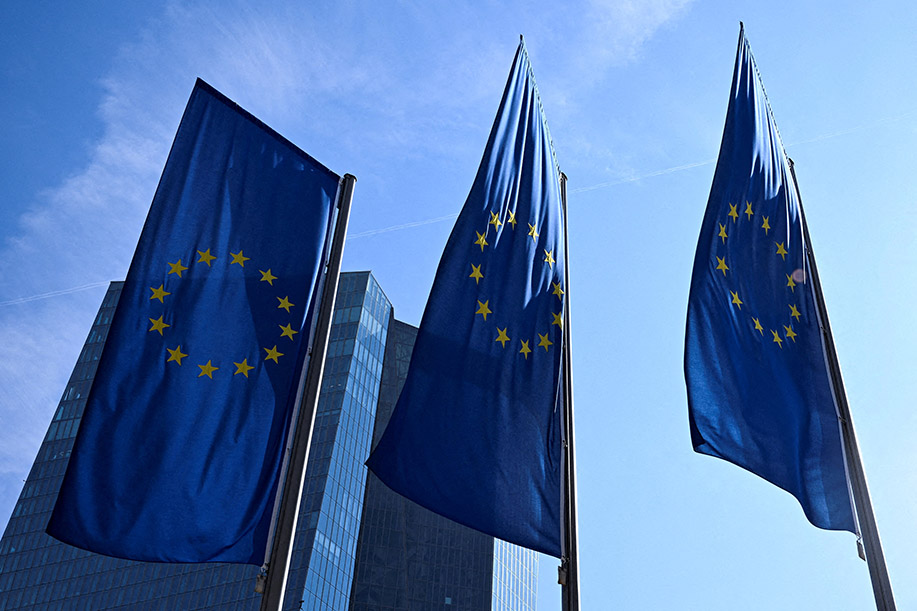
The European Central Bank is expected to hike interest rates next week, becoming the first of the biggest central banks to do so since the Iran war unleashed an energy crisis that is stoking inflationary pressures in the euro zone.
But with the economy of the 21-country bloc weaker than during Europe’s previous energy crisis in 2022, policymakers are walking a tightrope as they try to contain rising prices without exacerbating the growth hit from the crisis.
Here are five key questions for markets:
1/ Is a June hike set in stone?
Pretty much.
Even dovish policymakers like Italy’s Fabio Panetta and Greece’s Yannis Stournaras back a move.
Beyond Thursday’s hike, don’t expect the European Central Bank to commit to further moves.
2/ What happens after June?
That depends on when the conflict is resolved and how much longer the Strait of Hormuz, a global energy artery, remains closed.
Rather than a big hiking cycle like in 2022, traders expect the ECB will raise rates once or twice more this year after June, mainly to signal it won’t tolerate inflation getting entrenched.
Traders see the next move most likely in September, while economists polled are more divided, with only 60% expecting a second hike.
Traders have scaled back their bets slightly as oil prices have dropped, having fully priced in three hikes for 2026 earlier in the war.
“Two rate hikes will likely be enough to bolster the ECB’s credibility without causing a major deceleration in the economy beyond what is already underway due to higher energy prices,” said UBS chief European economist Reinhard Cluse.
3/ Is inflation spreading to the broader economy?
Potentially more than when the ECB last met in April.
Euro zone inflation rose further to 3.2% in May, with services and underlying inflation excluding food and energy prices increasing for the first time since the war.
That may be a sign that price pressures are starting to broaden, economists say. But Easter may have impacted the data and food inflation has slowed, so they want to see more details.
Because price pressures take time to spread, forward-looking indicators are a focus.
Two sources of concern have been the rise in firms’ selling price expectations and higher medium-term consumer inflation expectations following the start of the war on February 28.
Selling price expectations stabilised in May, however, and an analysis found that only a third of the bloc’s largest companies have indicated they are raising prices, less than in 2022.
Consumer inflation expectations also stabilised or dropped in April and long-term expectations remain near the ECB’s 2% target. That may all give policymakers some comfort.
True signs of second-round effects have not appeared in wage dynamics and inflation expectations yet, ING’s head of global macro Carsten Brzeski said.
But policymakers say it would be too late if they waited to see a wage impact before acting, as these come with long time lags.
4/ What will the ECB’s new projections show?
The bank is likely to revise up its inflation forecast, ECB Chief Economist Philip Lane says. Economists also expect growth downgrades.
It will also update the alternative scenarios it published in March. Current oil and gas prices leave the outlook between the ECB’s baseline and adverse scenarios, although the energy shock has persisted beyond what the adverse scenario assumed, board member Isabel Schnabel said.
Also watch the core inflation forecast as a sign of how worried the ECB is about broadening price pressures.
“If they revise up the forecasts a lot for core inflation, that is something that can increase market expectations about rate hikes,” said Pia Fromlet, economist at SEB.
5/ Is the ECB worried about private credit and AI risks?
For now, the ECB says the euro zone isn’t facing systemic risk from the recent turbulence in private credit, as the bloc’s financial institutions have limited direct exposure even if some pockets are exposed.
On AI, the risk in focus is cyber threats from the latest artificial intelligence models. The ECB will ask banks to take proactive defence measures, board member Frank Elderson said on Wednesday.
(Editing by Dhara Ranasinghe and Catherine Evans)