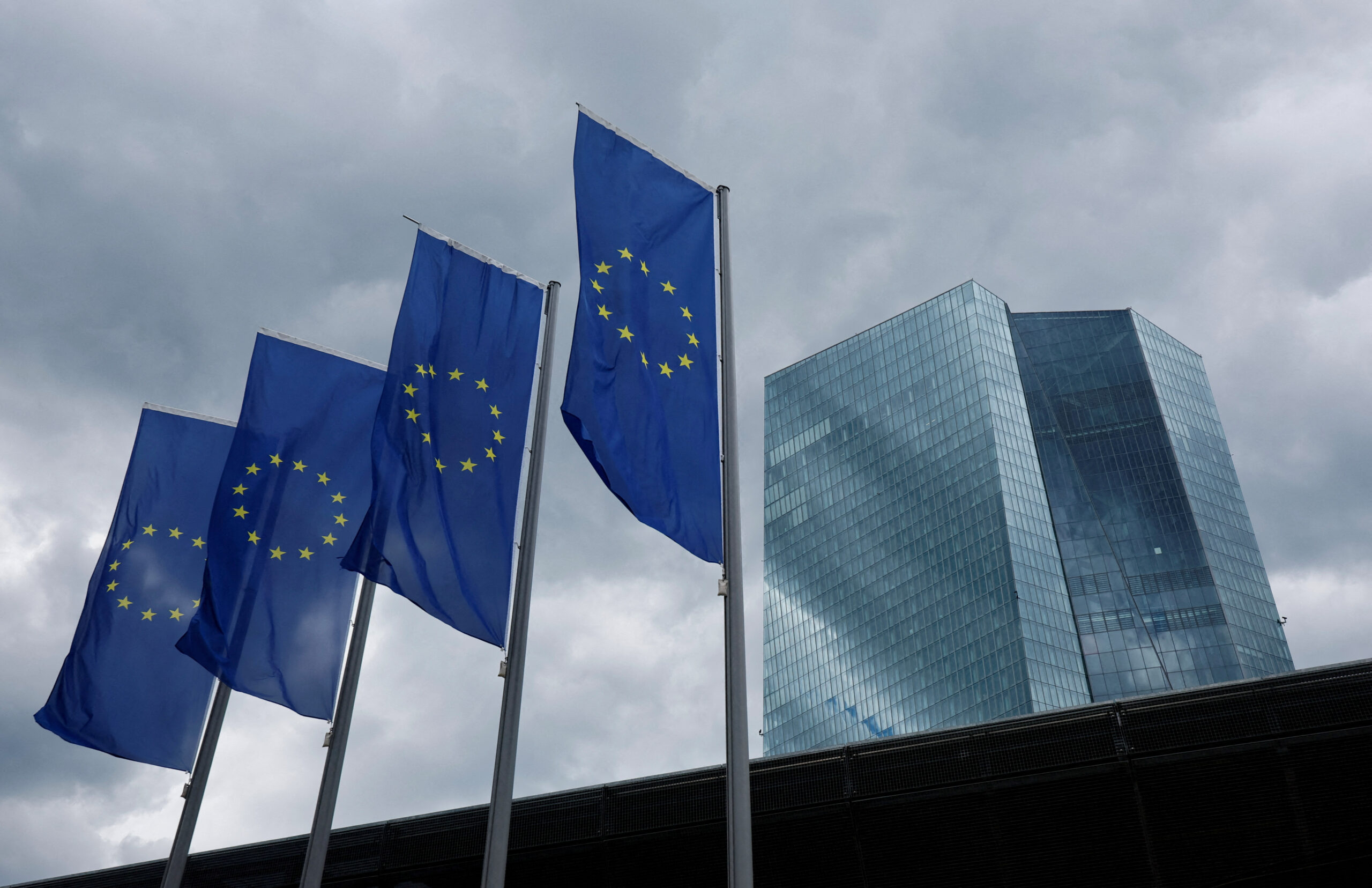
Europe’s push to curb its dependence on U.S. payments giants Visa and Mastercard has driven a wedge between the European Central Bank and financial firms keen to shield revenues, hobbling efforts to build a home-grown system, several people involved said.
A surge in cashless payments since the COVID-19 pandemic has increased the euro zone’s reliance on U.S. firms, which handle nearly two thirds of card payments in the bloc. Companies such as PayPal and Apple have also expanded.
European policymakers have made payments sovereignty a strategic priority, as a fragmenting global order raises the risk of access to payments systems being weaponised and new forms of money challenge the euro’s role.
The ECB is looking to introduce a digital euro by 2029 – essentially an online wallet guaranteed by the ECB but operated by private companies including banks.
European banks, however, have expressed concerns that a digital euro would see customers transfer some cash from banks to the safety of an ECB-guaranteed wallet, and are exploring different options.
On Wednesday, 25 more banks, including ABN Amro and Sabadell, joined a European consortium planning to launch a euro-pegged cryptocurrency.
“Public and private actors are moving in the same strategic direction, but with misaligned incentives and timelines,” said Paolo Gusmerini, director for digital banking at consultancy PwC.
CAP ON MERCHANT FEES
The financial sector’s concerns have held up legislation, in the European Parliament, to issue a digital currency for three years.
Fernando Navarrete, the EU lawmaker overseeing the legislation, said that negotiations regarding the exact role of the digital euro were still ongoing though he expected a final vote to take place before the end of the summer.
“Europe is moving toward payment sovereignty by developing both private interoperable payment solutions and the digital euro. The real challenge is to make the development of both options compatible and efficient without imposing additional costs on citizens,” Navarrete said.
“And that depends on the design choices and incentives we agree upon in European legislation.”
The ECB plans to supply for free the infrastructure it is building to support digital euro payments and to cap merchant fees for accepting them.
With euro zone card payments worth around 3.4 trillion euros ($3.9 trillion) a year, the cap could cost the private payments system 8 billion to 9 billion euros in lost annual revenues, calculations on ECB data show.
One way to offset that hit could be by lowering interchange fees – the transaction fees the cardholder’s bank charges to the retailer’s bank, analysts say.
“The digital euro still needs to address questions around acceptance and how the commercial value chain will work,” said Kunal Jhanji, BCG’s head of payments for Europe, Middle East, Africa and South America.
Euro zone merchants pay about 3.75 billion euros a year in debit card fees alone, roughly half to non-EU schemes and the rest to banks, ECB data shows.
To cap its impact on the wider financial sector, the digital euro legislation will set a limit on individual holdings, currently expected at 3,000 euros. That leaves scope for European banks, payments companies and tech startups to operate their own systems in parallel, although industry insiders and public officials pointed to the risks of having multiple systems that are more exposed to cyberattacks and technical failures.
Academic and former ECB senior official Ulrich Bindseil recently described imposing a cap as “a serious defeat”.
“We would expect commercial bank money to be junior to central bank money, not the opposite,” Bindseil said.
FRAGMENTATION
The ECB sees the digital euro as a way to give the euro zone a single payments backbone the private sector never delivered.
As legal tender, it would have to be accepted by merchants, helping spread common standards across the bloc.
“Once the regulation is adopted, there will be certainty these standards will become widespread … and open for private solutions to use,” said Ignacio Terol, who leads the ECB’s digital euro strategy unit.
National payment systems such as Italy’s Bancomat or Spain’s Bizum have worked instead on interlinking their existing networks.
Bizum this month started expanding its person-to-person instant payment services directly to merchants, with Paris-based Wero moving in the same direction.
However, Terol noted that banks distributing services such as Bizum are already reaping payment revenue from international card partners – which could prevent them from making a competitive offer to a retailer to accept Bizum.
Norman Wooding, founder and CEO of crypto services provider Scrypt, warned that rapid shifts in payments innovations by the private sector risked outpacing the ECB’s project.
“Innovation is structurally ahead of regulation – you’re assessing an orange in 2026 and by 2029 that could be an apple, or a banana. The delays are kneecapping,” he said.
($1 = 0.8624 euros)
(Reporting by Jesús Aguado)