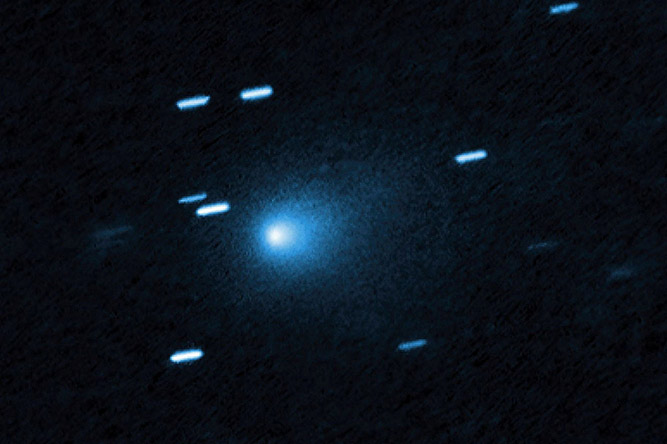
Scientists studying the comet 3I/ATLAS have determined that this interstellar visitor is remarkably ancient – formed an estimated 10 to 12 billion years ago in a primordial planetary system – and has a composition unlike anything in our solar system.
An evaluation of the chemical make-up of 3I/ATLAS – only the third interstellar object ever spotted in the solar system – provided guidance about the physical and chemical conditions in the planetary system where it formed, the researchers said.
The comet, which has a diameter of around 1.6 miles (2.6 km), is probably the oldest-known object to venture through the solar system, according to Martin Cordiner, a planetary scientist and astrochemist working at NASA’s Goddard Space Flight Center in Greenbelt, Maryland and lead author of the study published on Monday in the journal Nature.
The researchers said that 3I/ATLAS appears to have been born in a much colder environment – roughly minus-405 degrees Fahrenheit (minus-243 degrees Celsius) – than the one in which Earth and other bodies in our solar system formed roughly 4.5 billion years ago. They said it has traveled a vast distance since it was somehow expelled from its home planetary system.
“We have never before seen an object like 3I/ATLAS,” Cordiner said.
The researchers measured the ratio of isotopes – different versions of chemical elements such as hydrogen and carbon – observed on 3I/ATLAS using the James Webb Space Telescope.
Its hydrogen isotopes offered evidence about temperature and radiation in the environment in which 3I/ATLAS formed. Its carbon isotope ratios offered clues about the composition of the interstellar gas cloud that gave rise to 3I/ATLAS and its home planetary system.
The comet’s water contained about 30 times more deuterium – a hydrogen isotope – than other comets in the solar system. Its carbon isotope ratios differed from those seen in objects in the solar system and in interstellar clouds and planet-forming disks of material around newborn stars relatively nearby.
Cordiner said 3I/ATLAS likely is a fragment left over from the planetary formation process around another star.
“Our James Webb Space Telescope observations tell us that the planet-forming environment of 3I/ATLAS’s host system was distinct from our own solar system. It was likely colder, and less metal rich, while being more heavily irradiated by UV and cosmic rays,” Cordiner said.
‘ELEMENTS FOR LIFE’
Nevertheless, 3I/ATLAS is rich in organic molecules including those bearing carbon, hydrogen, nitrogen, oxygen and sulfur. This, according to Cordiner, “shows that despite a cold and distant origin, the volatile elements for life as we know it were abundant in this distant planet-forming disk.”
The carbon composition indicated that 3I/ATLAS formed as much as 12 billion years ago during a period of intense star formation in its region. The universe is thought to have begun with the Big Bang event about 13.8 billion years ago, meaning 3I/ATLAS would date to a time when the cosmos was only about 13% of its current age.
The researchers believe 3I/ATLAS formed in the Milky Way, but based on its age cannot rule out an origin in another galaxy.
“I had anticipated that intergalactic distances were too vast, but in fact it could take as little as a billion years for a fast interstellar object to get here from our nearest galactic neighbors, the Magellanic Clouds,” Cordiner said.
3I/ATLAS may have been hurled from its home planetary system due to gravitational interactions with planets, though a collision of some sort also is considered a possibility.
The two other interstellar objects previously observed journeying through the solar system were comets called 1I/’Oumuamua, detected in 2017, and 2I/Borisov, discovered in 2019.
3I/ATLAS is now approaching the orbit of the planet Saturn and is expected to pass beyond the dwarf planet Pluto’s orbit in 2029 and exit the solar system’s outer boundary in around 2035.
The researchers are confident 3I/ATLAS is a natural object, despite some speculation last year by others that it was an alien spacecraft.
“While good scientists always remain open to updating their understanding, we take great care to weigh the evidence for each hypothesis,” Cordiner said. “In this case, the evidence was clear from a very early stage that we were looking at a comet-like object, and over time that interpretation has been confirmed by subsequent observations.”
(Reporting by Will Dunham)