The universe has two kinds of matter. There is invisible dark matter, known only because of its gravitational effects on a grand scale. And there is ordinary matter such as gas, dust, stars, planets and earthly things like cookie dough and canoes.
Scientists estimate that ordinary matter makes up only about 15% of all matter, but have long struggled to document where all of it is located, with about half unaccounted for. With the help of powerful bursts of radio waves emanating from 69 locations in the cosmos, researchers now have found the “missing” matter.
It was hiding primarily as thinly distributed gas spread out in the vast expanses between galaxies and was detected thanks to the effect the matter has on the radio waves traveling through space, the researchers said. This tenuous gas comprises the intergalactic medium, sort of a fog between galaxies.
Scientists previously had determined the total amount of ordinary matter using a calculation involving light observed that was left over from the Big Bang event roughly 13.8 billion years ago that initiated the universe. But they could not actually find half of this matter.
“So the question we’ve been grappling with was: Where is it hiding? The answer appears to be: in a diffuse wispy cosmic web, well away from galaxies,” said Harvard University astronomy professor Liam Connor, lead author of the study published on Monday in the journal Nature Astronomy.
The researchers found that a smaller slice of the missing matter resides in the halos of diffuse material surrounding galaxies, including our Milky Way.
Ordinary matter is composed of baryons, which are the subatomic particles protons and neutrons needed to build atoms.
“People, planets and stars are made of baryons. Dark matter, on the other hand, is a mysterious substance that makes up the bulk of the matter in the universe. We do not know what new particle or substance makes up dark matter. We know exactly what the ordinary matter is, we just didn’t know where it was,” Connor said.
So how did so much ordinary matter end up in the middle of nowhere? Vast amounts of gas are ejected from galaxies when massive stars explode in supernovas or when supermassive black holes inside galaxies “burp,” expelling material after consuming stars or gas.
“If the universe were a more boring place, or the laws of physics were different, you might find that ordinary matter would all fall into galaxies, cool down, form stars, until every proton and neutron were a part of a star. But that’s not what happens,” Connor said.
Thus, these violent physical processes are sloshing ordinary matter around across immense distances and consigning it to the cosmic wilderness. This gas is not in its usual state but rather in the form of plasma, with its electrons and protons separated.
The mechanism used to detect and measure the missing ordinary matter involved phenomena called fast radio bursts, or FRBs – powerful pulses of radio waves emanating from faraway points in the universe. While their exact cause remains mysterious, a leading hypothesis is that they are produced by highly magnetized neutron stars, compact stellar embers left over after a massive star dies in a supernova explosion.
As light in radio wave frequencies travels from the source of the FRBs to Earth, it becomes dispersed into different wavelengths, just as a prism turns sunlight into a rainbow. The degree of this dispersion depends on how much matter is in the light’s path, providing the mechanism for pinpointing and measuring matter where it otherwise would remain unfound.
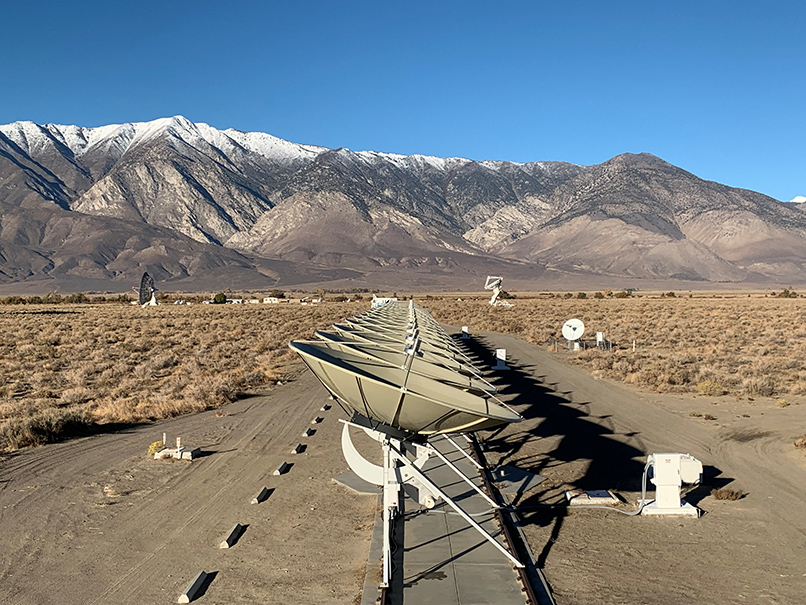
Scientists used radio waves traveling from 69 FRBs, 39 of which were discovered using a network of 110 telescopes located at Caltech’s Owens Valley Radio Observatory near Bishop, California, called the Deep Synoptic Array. The remaining 30 were discovered using other telescopes.
The FRBs were located at distances up to 9.1 billion light-years from Earth, the farthest of these on record. A light-year is the distance light travels in a year, 5.9 trillion miles (9.5 trillion km).
With all the ordinary matter now accounted for, the researchers were able to determine its distribution. About 76% resides in intergalactic space, about 15% in galaxy halos and the remaining 9% concentrated within galaxies, primarily as stars or gas.
“We can now move on to even more important mysteries regarding the ordinary matter in the universe,” Connor said. “And beyond that: what is the nature of dark matter and why is it so difficult to measure directly?”
(Reporting by Will Dunham)