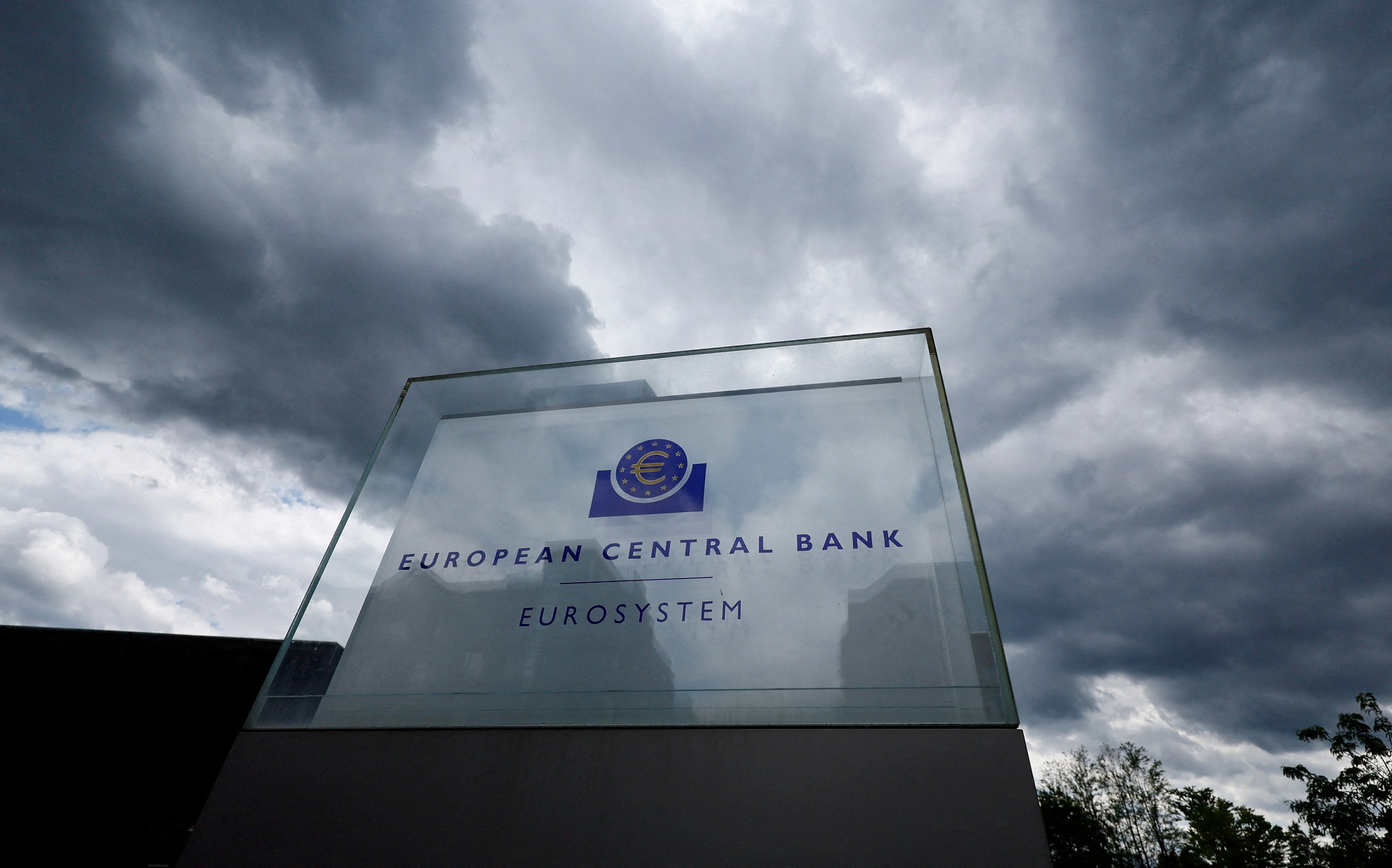
The European Central Bank is set to cut rates again on Thursday, but investors haven’t been this unsure in a while on what comes next.
U.S. tariff risks are intensifying while the ECB may have to grapple with the impact of a new German government, a potential Ukraine ceasefire and an expected surge in defence spending.
Meanwhile, policymakers look increasingly divided on how fast they’ll cut rates from here after five moves since June.
“It’s no longer a case of automatic pilot, reducing rates at every meeting,” Zurich Insurance Group’s chief market strategist Guy Miller said.
Here are five key questions for markets:
1/ What will the ECB do on Thursday?
That’s simple: cut its key rate by another 25 basis points to 2.50%.
The assessment of financing conditions is also in focus as this could be a way to hint at the post-March rate outlook.
“It will be important to see if the statement reiterates that ECB policy is still restrictive or if we are more at a neutral stance,” ING’s global head of macro, Carsten Brzeski, said.
Any comments on the fallout of last week’s ECB payment systems outage may also be a focus.
2/ Will rate cuts continue after March?
Markets think so, but expect a bumpier path ahead.
They price in just under 90 bps of rate cuts by year-end – three more moves to 2% and a chance of a fourth to 1.75%. That’s in line with a neutral rate that neither stimulates nor restricts growth the ECB estimates at 1.75%-2.25%.
Still, traders anticipate around a 70% chance of an April cut, highlighting uncertainty.
Many policymakers sound on board with markets’ ultimate expectation, but the debate on the pace is heating up.
Top hawk Isabel Schnabel, for example, questions whether ECB policy is still restrictive, though policymakers widely feel it still is.
So, some governors may push for a pause in April, Swedish bank SEB reckons.
But wage growth – thought to have underpinned the high services inflation which has been worrying hawks – will fall fast, an ECB tracker suggests. And data on Friday suggested the inflation outlook, including services, is improving.
Portugal’s Mario Centeno, a dove, warns that inflation could drop below target given a weak economy.
3/ How will the ECB assess the impact of tariffs so far?
To date only a 10% U.S. tariff against China has gone into effect, so the ECB won’t factor them into policy yet.
Against Europe, U.S. President Donald Trump has announced a 25% tariff on steel and aluminium imports from March 12. He is also looking at reciprocal tariffs on every country taxing U.S. imports, possibly including value added taxes.
Last week, Trump floated a 25% “reciprocal” tariff on European cars and other goods.
The latest threat would shrink the European economy by 0.4% within the first year, Germany’s Kiel Institute estimates, a big blow given that the euro zone is seen growing just 0.9% in 2025.
But it remains to be seen whether tariffs are more of a negotiating tool.
The ECB will wait until April to see what is imposed, ING’s Brzeski said.
4/ What would a Ukraine ceasefire mean for the ECB?
Investors reckon a Ukraine ceasefire would support the economy and lower energy prices, but only modestly.
Berenberg chief economist Holger Schmeiding said a ceasefire would likely have a marginal impact on the ECB’s thinking. “Tariffs will have a bigger impact,” he added.
Ukraine talks sidelining Europe have also raised pressure to bolster Europe’s defences, likely requiring hundreds of billions of euros of public spending.
It’s early days, but Barclays reckons more fiscal spending could prompt fewer rate cuts. Others, such as Citi, think higher longer-term borrowing costs may mean more cuts.
5/ What will latest ECB projections show?
Growth at the end of 2024 was lower than the ECB’s December forecasts, so expect a downgrade to growth projections for the third time running.
On inflation, energy prices have risen since the last forecasts, so a small upward revision is expected to this year’s number.
(Reporting by Stefano Rebaudo and Yoruk Bahceli)