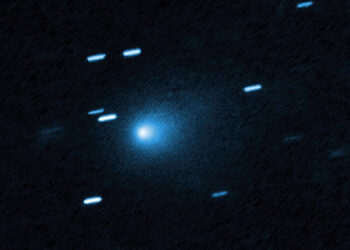
In 1995, astronomers confirmed the discovery for the first time of a brown dwarf, a body too small to be a star and too big to be a planet – sort of a celestial tweener. But it turns out that was not the full story.
Researchers now have taken a fresh look at that brown dwarf and learned that it actually is not a single brown dwarf but rather two of them orbiting astonishingly close to each other while circling a small star. This was documented in two new studies using telescopes in Chile and Hawaii.
These two brown dwarfs are gravitationally locked to each other in what is called a binary system, an arrangement commonly observed among stars. So the brown dwarf that three decades ago was named Gliese 229B is now recognized as Gliese 229Ba, with a mass 38 times greater than our solar system’s largest planet Jupiter, and Gliese 229Bb, with a mass 34 greater than Jupiter.
They are located 19 light-years from our solar system – rather close in cosmic terms – in the constellation Lepus. A light year is the distance light travels in a year, 5.9 trillion miles (9.5 trillion km).
Binary brown dwarfs are a rarity. These two orbit each other every 12 days at a distance of only 16 times the separation between Earth and the moon. Only one other pair of brown dwarfs are known to orbit as close to each other as this twosome.
Brown dwarfs are neither a star nor a planet, but something in between. They could be considered wannabe stars that during their formative stages did not reach the mass necessary to ignite nuclear fusion at their core like a star. But they are more massive than the biggest planets.
“A brown dwarf is an object that fills the gap between a planet and a star. They are formally defined as objects that can burn a heavy form of hydrogen, called deuterium, but not the most common basic form of hydrogen,” said Sam Whitebook, a graduate student in Caltech’s division of physics, mathematics and astronomy and lead author of one of the studies, published in the Astrophysical Journal Letters.
“In practice, this means they range in mass from approximately 13 to 81 times the mass of Jupiter. Because they can’t fuse hydrogen, they can’t ignite the fusion channels that power most stars. This causes them to just glow dimly as they cool down,” Whitebook said.
The year 1995 was big for astronomers, with the discovery of the first planet beyond our solar system – an exoplanet – also being announced. Until Gliese 229B’s discovery, the existence of brown dwarfs had only been hypothesized. But there were anomalies about Gliese 229B, particularly after its mass was measured at about 71 times that of Jupiter.
“This didn’t make any sense since an object of that mass would be much brighter than Gliese 229B,” said Caltech astronomer Jerry Xuan, lead author of one of the studies, published in the journal Nature. “In fact, some models predict that objects with masses above 70 Jupiter masses fuse hydrogen and become stars, which was clearly not happening here.”
The new observations were able to discern two separate brown dwarfs. They orbit a common type of star called a red dwarf with a mass about six-tenths that of our sun. While both brown dwarfs are more massive than Jupiter, their diameter is actually smaller than the gas giant planet because they are more dense.
“We still don’t really know how different brown dwarfs form, and what the transition between a giant planet and a brown dwarf is. The boundary is fuzzy,” Xuan said. “This finding also shows us that brown dwarfs can come in weird configurations that we were not expecting. This goes to show how complex and messy the star formation process is. We should always be open to surprises.”
(Reporting by Will Dunham)