Bullets and bombs were a part of life in the Belfast that Raied al-Wazzan moved to from Iraq in 1990, but he never felt threatened as a member of one of the divided region’s tiny ethnic minorities.
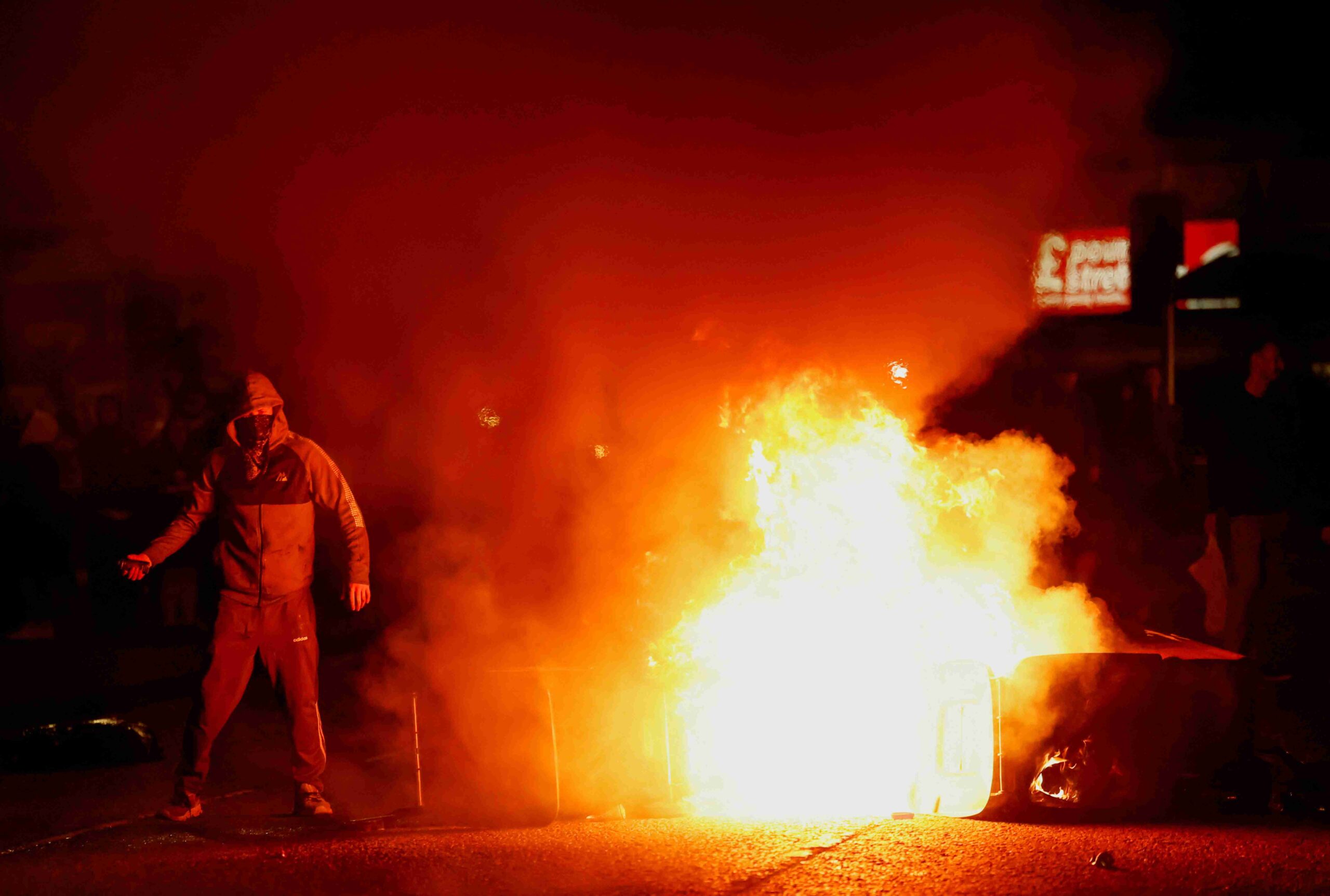
But after a week when masked anti-immigrant rioters attacked police and set the homes of migrants on fire, fear has set in.
“There are certain areas I cannot go by myself or even drive through,” said Al-Wazzan, the vice-chair of the Northern Ireland Council for Racial Equality, an umbrella group for a number of organisations representing ethnic minorities.
“I used to live in some of these areas, but today it’s not safe for me or (my) family or people who have a different colour of skin.”
The eruption of what police described as mob-led “racist thuggery” is particularly dangerous in Northern Ireland due to its legacy of sectarian violence and lingering role of paramilitary groups with a history of stoking street disorder.
More than 3,600 people were killed between 1968 and 1998 in a conflict between mainly Catholic Irish nationalists seeking Irish unity, predominantly Protestant pro-British “loyalists” wanting to stay in the United Kingdom and the British military.
But while segregation along sectarian lines remains common, particularly in housing and education, the number of recorded race hate crimes is now double that of sectarian offences, which they surpassed almost a decade ago, police data shows.
“The last week’s events have not come out of nowhere,” said Patrick Corrigan, the local director of Amnesty International, who knew of women and children fleeing to their attic to breathe through a skylight when rioters lit fires downstairs.
“We have a serious problem of endemic racist violence, at times fuelled by paramilitary organisations, a particularly sinister element in this part of the world where you have masked men who have recourse to violence to try to tell people where they’re allowed to live or where they’re not,” Corrigan said.
While the 1998 Good Friday Agreement led to the disarming of the main Irish Republican and loyalist militant groups, splinter factions endure.
Such groups continue to exert control over some communities through intimidation, financial extortion and drug dealing, and have been involved in racially motivated attacks, the body that monitors paramilitary activity said earlier this year.
Corrigan said migrants within WhatsApp groups he is part of were “clearly terrified”, reluctant to leave their homes to go to work and their children afraid to walk to school.
That sentiment is shared by Nathalie Donnelly, who runs a weekly English class as part of the UNISON trade union’s migrant worker project. Half her students were now too scared to attend, she said.
“I think we are just one petrol bomb away from a serious loss of life,” Corrigan said.
‘CLEARLY TERRIFIED’
The violence flared first and was most intense in Ballymena after two 14-year-old boys were arrested and appeared in court, accused of a serious sexual assault on a teenage girl in the town. The charges were read via a Romanian interpreter to the boys, whose lawyer told the court that they denied them.
Ballymena, 45 kilometres (28 miles) from Belfast, is a mainly Protestant working-class town that was once the powerbase of Ian Paisley, the fiercely pro-British preacher-politician who died in 2014.
Most of the other areas where anti-immigrant violence spread last week – Larne, Newtownabbey, Portadown and Coleraine – were similar, mostly Protestant towns.
At the outset of the “Troubles”, some Catholics and Protestants were violently forced from their homes in areas where they were in the minority, and sectarian attacks remained common through three decades of violence and the imperfect peace that followed.
“Sectarianism and racism have never been very different from each other,” said Dominic Bryan, a professor at Queens University Belfast who researches group identity and political violence.
“It doesn’t totally surprise me that as society changes and Northern Ireland has become a very different society than it was even 30 years ago, that some of this ‘out grouping’ shifts,” Bryan said, adding that such prejudices could also be seen among Irish nationalists.
Immigration has historically been low in Northern Ireland, where the years of conflict bred an insular society unused to assimilating outsiders.
There are other factors at play too, said Bryan. The towns involved all have big economic problems, sub-standard housing and rely on healthcare and industries such as meat packing and manufacturing that need an increasing migrant workforce.
“The people around here, they’re literally at a boiling point,” said Ballymena resident Neil Brammeld. The town’s diverse culture was welcomed and everybody got along, he said, but for problems with “a select few”.
“The people have been complaining for months and months leading up to this and the police are nowhere to be seen.”
While around 6% of people in the province were born abroad, with those belonging to ethnic minority groups about half that, the foreign-born population in Ballymena is now much higher, in line with the UK average of 16%.
Northern Ireland does not have specific hate crime legislation, although some race-related incidents can be prosecuted as part of wider laws.
Justice Minister Naomi Long pledged last year to boost those existing provisions but said the power-sharing government would not have enough time to introduce a standalone hate crime bill before the next election in 2027.
While five successive nights of violence mostly came to an end on Saturday, the effects are still being felt.
“I’m determined that I’m not going to be chased away from my home,” said Ivanka Antova, an organiser of an anti-racism rally in Belfast on Saturday, who moved to Belfast from Bulgaria 15 years ago. “Racism will not win.”
(Reporting by Padraic Halpin and Amanda Ferguson)