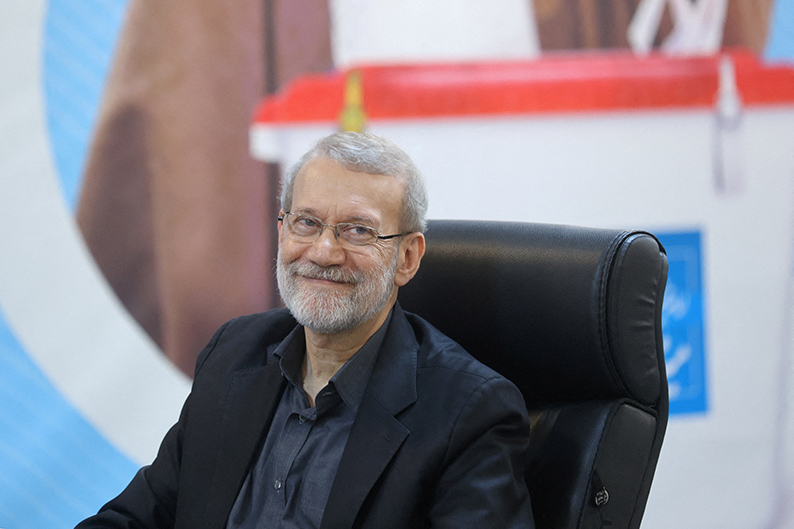
The killing of Iran’s most influential powerbroker, Ali Larijani, has pushed the Islamic Republic into a more uncertain phase, complicating decision-making in Tehran and narrowing its options as the war grinds on.
The U.S.-Israeli war on Iran began with the killing of Supreme Leader Ayatollah Ali Khamenei alongside a group of military commanders, and shows no sign of abating, with several more senior officials now targeted by air strikes.
The deeper challenge for Tehran is increasingly structural. A system built for endurance is being tested by attrition. As experienced officials are picked off in targeted killings, the pool of figures capable of managing both war and statecraft is shrinking.
Four senior Iranian officials said there were few figures in the establishment like Larijani who could translate battlefield realities into political strategy — a gap that could slow decision-making and coordination.
Iran’s security chief Larijani combined rare clerical legitimacy, rooted in his prominent religious family, with the stature of a seasoned politician who had deep ties to the Islamic Revolutionary Guards Corps (IRGC).
Those credentials made him a trusted intermediary in a system where power centres — from clerics to the security apparatus — often compete for influence, one of the officials said.
Alex Vatanka, a senior fellow at the Middle East Institute in Washington, D.C., said Larijani’s death and those of many other senior figures will “obviously upset the political process in Tehran and might even jeopardise policy continuity or policy flexibility.”
The Islamic Republic has long been structured to withstand the loss of senior officials, two of the officials said, but they added that replacing Larijani as a powerbroker under wartime conditions will be far more difficult.
Another official said the immediate effect is “not necessarily weakness of the Islamic Republic, but disarray,” because losing someone like Larijani risks making governance more fragmented and reactive.
SURVIVAL TRUMPS IDEOLOGY
Larijani’s death is likely to tilt the system further toward its security institutions, tightening control but reducing flexibility — both in prosecuting the war and in shaping any eventual endgame, analysts said.
Ali Vaez, the International Crisis Group’s Iran Project Director, said Larijani’s removal would not paralyse the system, but it “would deprive it of yet another senior figure capable of exercising prudence at a dangerous moment”.
“With every assassination, Iran moves further away from democratic opening and closer to either praetorian rule or state collapse,” said Vaez.
All the officials who spoke to Reuters said the establishment’s main goal was survival.
“The regime as a whole has always been anchored around the Iran of survival and expediency. In that sense, they are ideological radicals who will go a long way in this war or as long as they can but will also look for a way out,” said Vatanka.
Analysts have ruled out an imminent collapse of the clerical rule in Iran amid the war or a military coup by the Guards, which have tightened their grip on wartime decision-making despite the loss of top commanders.
Asked about the possibility of a coup, Vaez said: “They do not need to. They’re already in full control”. One of the officials said the Guards are committed to the system of velayat-e faqih, or guardianship of the Islamic jurist.
A senior reformist former official said the core supporters of the clerical establishment number around 12 million people, and “many of them support the Islamic Republic because they believe in a system run by a religious figure.”
ATTENTION TURNS TO QALIBAF
If Israel’s targeted killing continues, the Islamic Republic may find that survival is not simply a matter of resilience but of replacement — and that replacing men like Larijani is far harder than the system was built to admit, analysts said.
With several top officials killed, parliament speaker Mohammad Baqer Qalibaf stands out as one of the few remaining figures with both military credentials and political clout.
Qalibaf, a former commander with close ties to the Guards and the new Supreme Leader Ayatollah Mojtaba Khamenei, has long cast himself as a strongman in the mold of a modernising authoritarian.
Sima Shine, a former chief Mossad analyst and currently a researcher at Israel’s Institute for National Security Studies, said the emerging power structure appears increasingly concentrated in Qalibaf and the security establishment.
“We assume that the IRGC and Qalibaf are the most important people now … It will be Qalibaf on the level of a decision, and the IRGC on the practical level of pushing the button,” Shine said.
Even so, Qalibaf lacks Larijani’s clerical pedigree and the same depth of relationships within Iran’s religious hierarchy. That deficit could complicate efforts to unify the system’s competing factions, even if it strengthens alignment with the security forces.
For now, the war may be buying the leadership time, rallying the state even as it weakens it. But that balance may not hold indefinitely. If the leadership begins to see a real risk to its survival, Shine said, it could become more willing to compromise “because the survival of the regime is the most important goal.”
(Additional reporting by Maayan Lubell )