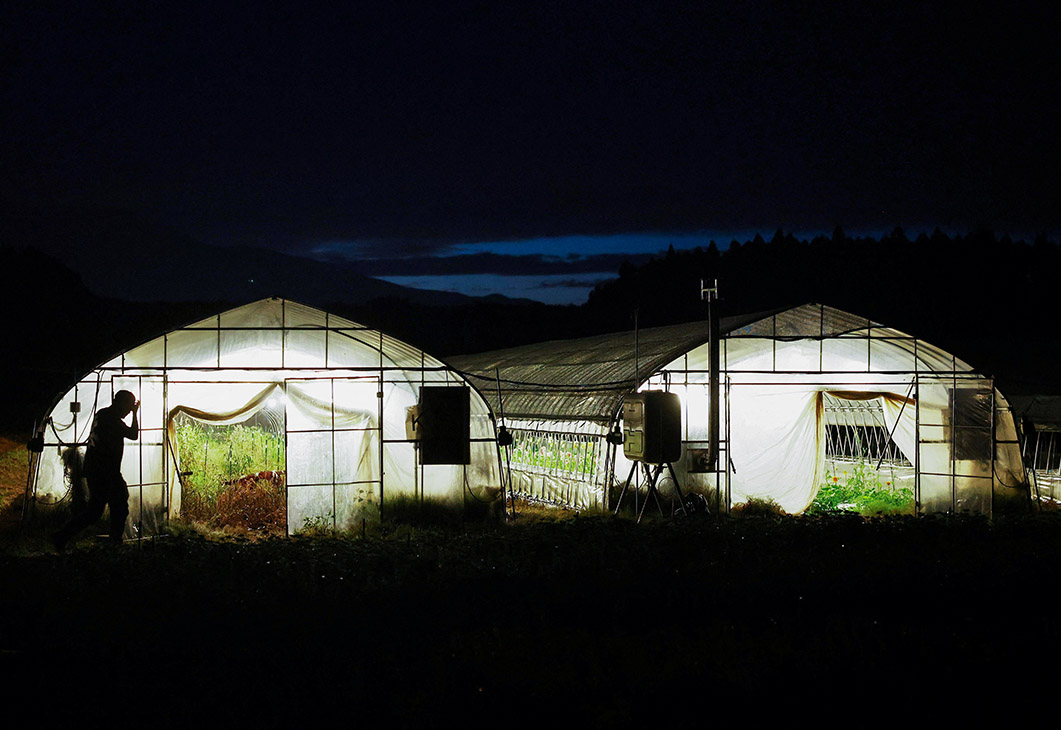
Long after sunset, Motoaki Iijima’s illuminated greenhouse north of Tokyo glows like a lantern as the flower farmer harvests pink and orange gerberas, avoiding a daytime sun fierce enough to be deadly.
As increasingly intense heatwaves turn Japanese summers into survival tests, farmers — from flower and asparagus growers to egg producers — are rewriting the agrarian clock.
Once-busy midday hours are now avoided as a mortal threat, replaced by after-dark work to protect crops, livestock and themselves.
Iijima, 36, converted his family’s centuries-old rice farm in the rural town of Nikko into a flower farm a decade ago.
Three summers ago, after a part-time worker suffered heatstroke picking sunflowers in his greenhouse, he made a dramatic change.
Outside temperatures above 35 degrees Celsius (95 degrees Fahrenheit) — increasingly common in his region — can push greenhouse interiors above 40 C. Now, Iijima works outdoors through the night, stopping only when the morning sun turns punishing again.
“The hours around dusk are really precious. That’s when we can be outside,” he says, wiping sweat from his forehead under rows of halogen lights. “We’ve gradually become nocturnal. It’s about protecting our bodies, and ultimately, our lives.”
From rice farmers in Vietnam to winery workers in Spain, farmers across the globe are shifting work to cooler nighttime and early-morning hours as they try to beat more frequent and intense heatwaves.
The numbers tell a stark story.
Japan is especially exposed: around 70% of its farmers are 65 or older, a population especially susceptible to heat stress, and high humidity amplifies the danger.
TOLL ON AGEING FARMERS
A record 59 agricultural workers succumbed to extreme heat in 2024 in Japan, more than double the death toll in 2021. About 60% of farmers in their 20s to 50s surveyed by Japan Weather Association last year said they had either personally suffered heatstroke or knew someone who had. Nearly 60% of farmers also shifted their working hours to earlier or later in the day.
In 2024 alone, heat exposure cost Japan’s agricultural sector 926 million labour hours — time workers could not safely spend in the fields — according to Lancet Countdown, a research collaboration that tracks the health impacts of climate change. Across all sectors, labour hours lost to heat nearly doubled from the 1990s average, translating to roughly $46 billion in lost income, or about 1% of Japan’s gross domestic product.
To adapt, workers at Iijima’s farm now start work up to two hours earlier. One veteran worker, 68-year-old Miyoko Asada, arrives at the farm shortly after sunrise.
“We’ve got to race against the clock,” she says, hurrying to cut purple asters alongside eight others in a vast field before temperatures climb past safety limits.
A few towns away, poultry farmer Tetsuya Usuba faces a different crisis.
POULTRY FARMER’S MIDNIGHT ROUTINE
Six summers ago, he lost over 500 laying hens to heatstroke during a three-day spell of intense heat. The experience still haunts Usuba — he and his father had to use a forklift fitted with a giant bucket to remove the birds from the barn.
Now, Usuba’s midnight routine is fixed: lights automatically flick on in two of his barns at 2:30 a.m., waking the 4,400 caged hens to eat before oppressive heat suppresses their appetite. He has installed additional fans, sprays water on the barn’s metal roofs, and adds citric acid to the hens’ drinking water. Still, when temperatures suddenly spiked above 35 C last month, he lost 130 birds.
“Summer has become a new threat to producers like us, something as scary as an outbreak of avian influenza,” the 48-year-old says. As he checked on his birds one recent afternoon, the thermometer read 33 C. Many of them were panting with their beaks ajar.
The government has taken note.
New workplace regulations introduced in 2025 require employers to establish heatstroke reporting procedures and emergency response plans. Japan is also promoting smart farming technologies such as the use of drones and robots to reduce workers’ heat exposure.
But on Iijima’s farm, adaptation remains intensely manual. In the early morning, workers hurriedly check the harvested flowers for wilting leaves before loading them onto trucks. It is not yet 8 a.m., and the morning is still bearable.
“Look, those leaves are already wilting,” one worker calls out.
Iijima pauses and glances at the overcast sky. Before long, the heat will return.
(Reporting by Mariko Katsumura)