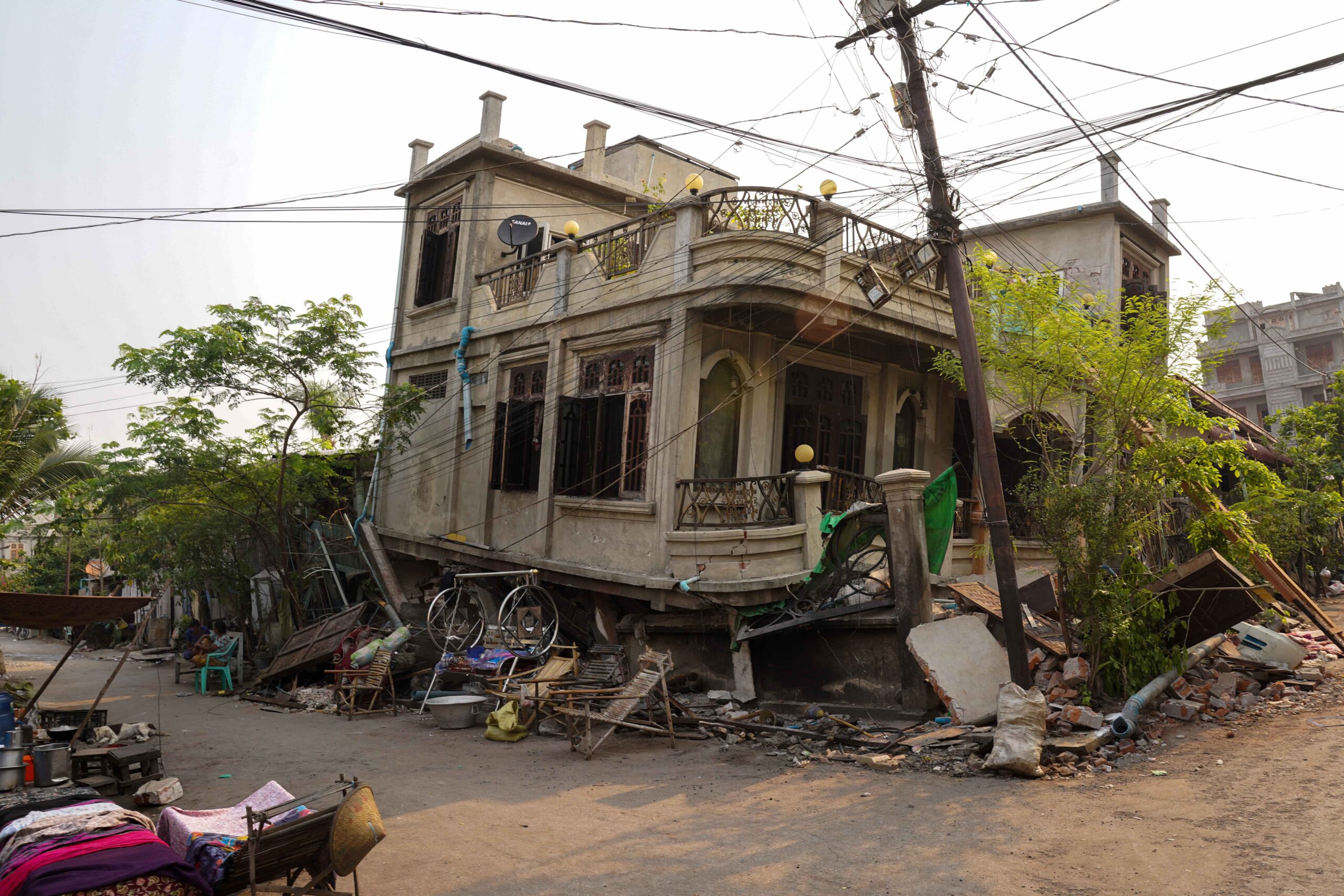
More than a week since a 7.7 magnitude earthquake struck Myanmar, turning buildings into concrete mortuaries where many of the 3,500 confirmed casualties still lie entombed, families do not yet know whether loved ones are among them.
That, in large part, is due to a lack of internet access that local residents and humanitarians say is severely impeding the disaster response in the Southeast Asian country.
Gus, a 30-year old LGBTQ+ activist living in the northwest region of Sagaing, said he is yet to learn the fate of two friends.
He knows they were in Mandalay, the epicentre, at the time the country’s deadliest earthquake hit on March 28.
“It’s so difficult to connect our friends, our families and our comrades to make sure that they are okay,” he told the Thomson Reporters Foundation. “I’m so worried about them.”
Communications have been under control of the military junta since it violently seized power from a democratic government in 2021 in an attempt to stifle opposition, which has come in the form of ethnic armed groups and a civil disobedience movement.
The military has been accused of killing close to 6,500 people since the coup in 2021 and imprisoning almost 30,000 people, including children.
Gus himself is living in hiding, wanted by the military for protesting and being a member of the LGBTQ+ community.
The crackdown on dissent has left almost a third of the country with no internet at all, whilst other parts have restricted access with firewalls blocking social media and news sites.
Despite a call from 120 global organizations saying that internet access is “essential for coordinating live-saving emergency responses,” the blackouts remain.
DIGITAL DICTATORSHIP
A “digital dictatorship” is denying communities access to lifesaving information and the ability to reach loved ones, said Yadanar Maung, a spokesperson for the activist and research group Justice For Myanmar.
“It is imperative that governments and companies in the telecommunications sector pressure the junta to immediately lift internet shutdown orders and censorship,” Maung said.
A humanitarian worker in the country, who could not be named for security reasons, reported how in areas with complete blackouts, residents have had to travel for several days to get connectivity to call in their needs to aid groups.
“It leads to an ineffective response,” he said.
A lack of communications, said Gus, meant three days passed before help reached his town.
The blackouts also meant that much of the Burmese population was denied news of the extent of the earthquake in the immediate aftermath.
More than 24 hours went by before Gus, and fellow members of the wider civil disobedience movement, learned that the earthquake had not just hit their locality but was in fact widespread.
He was only able to learn the extent of the devastation via access to one of the few clandestine Starlink connections belonging to business owners in the area.
Starlink is a portable Internet device that operates via a direct connection to a satellite, provided by Elon Musk’s Space X. But at a starting price of $389, it is out of reach for most Burmese who earn an average of 4,800 Burmese kyat ($2.20) a day.
For 1,000 Burmese kyat ($0.48) for two hours, Gus, who currently has no means of earning, was able to read the latest earthquake developments.
He said he believes the lack of internet access stems from the military’s intent to stop Burmese citizens from learning “of their crimes and harsh treatment of their own people.”
Reports have emerged of military-led attacks on earthquake-affected areas since the catastrophe and aid being thwarted on its way to those in need.
ROLE OF SATELLITES AND AI
Technology like Starlink is enabling the humanitarians who have flown in to mobilise when internet access is unavailable and delivery routes are being blocked, experts said.
“Starlink can provide vital connectivity when terrestrial internet is unavailable – in this case both because of earthquake damage to communications infrastructure and because of pre-existing regime internet and mobile phone shutdowns for security reasons that have not been lifted,” Richard Horsey, senior adviser on Myanmar at the International Crisis Group, said in an email.
“But Starlink is expensive, and there are not that many units on the ground.”
Satellites and AI are being relied upon for communication and response planning when possible, although multiple aid agencies said they could not divulge specifics for fear of military reprisals.
Chinese rescue teams are reportedly using a specially created AI translation tool via its DeepSeek programme to help communicating in English and in Burmese with local residents.
The European Union’s Copernicus is another useful tool, Horsey said, in conducting remote damage assessments, giving a rapid over-arching picture of the situation.
Microsoft’s AI for Good Lab is doing something similar. Aerial pictures captured by its 15 Planet Labs satellites are being analysed by AI to reveal the areas most damaged.
Such images, the humanitarian worker said, have enabled organisations to identify locations where people have congregated as well as sites of the most severe damage.
But there are challenges posed by cloud coverage, he said, as the country is experiencing heavy rains, while “political restrictions” limit the frequency of drone trips.
“None of (these tools) are as effective as being able to go unimpeded where we would like to go,” he said, adding that talking to members of communities and in-person assessments would be better than simply guessing what people need based on images.
(Reporting by Rebecca L. Root;)