As Volkswagen and unions gear up for the next round of talks over wages and plant closures in Germany, company and industry data reviewed by Reuters show that the automaker spends a higher proportion of sales on labour costs than major rivals.
The data, in an internal memo by Volkswagen’s works council reviewed by Reuters, underscores the company’s challenge to remain competitive in its pricey home market as cheaper models from China arrive.
Management will start the next round of negotiations with unions representing roughly 120,000 German workers on Thursday. Unions are demanding a 7% pay rise, while Volkswagen is threatening a 10% cut.
The proportion of revenue spent on labour at Volkswagen globally has fallen from 18.2% in 2020 to 15.4% in 2023 – but that ratio still exceeds BMW, Mercedes-Benz, and Stellantis, which spent between 9.5% and 11% in 2023, according to the works council memo.
At VW AG, the German subsidiary that governs the six plants in question, the ratio was estimated at 15.8-17.5%. Volkswagen says it does not release separate figures for VW AG.
The findings by the works council, an elected body of employees representing them in negotiations with management, are based on annual reports showing companies’ global spending on personnel compared to revenue. The figures include all staff, from factory to white-collar workers. Reuters checked and confirmed the calculations.
Part of the reason the company spends more on labour is that it makes many components, and software, in-house, Stifel analyst Daniel Schwarz said. But pressure on margins from China means the company needs to cut fixed costs.
“The VW brand has been market leader in Europe every year since 2005 … its cars are competitive. The problem is not the product, but the costs,” he told Reuters.
Germany, where Volkswagen employs nearly 45% of its workforce, has the highest labour costs of any passenger car industry worldwide, averaging 62 euros ($66) per hour in 2023, up around a third from a decade ago, according to the German autos association VDA.
Still, union representatives say labour is a small part of the company’s cost base, challenging management to make cuts elsewhere to boost flagging profits.
In an internal flyer to staff, the works council pointed to steep drops in earnings at other parts of the group – Porsche, Audi, and VW Financial Services – in the first nine months of the year, which it said cost the company 5.5 billion euros ($5.8 billion).
“That alone is an argument for why it’s not enough to put labour costs at the centre of communication,” it wrote.
VW AG’s plants are the only car factories in Germany, except Tesla’s, where wages are not determined by an industry-wide collective agreement for the auto and engineering sectors, but by a separate agreement.
Volkswagen cancelled that agreement in September to seek cuts at the VW brand which it says are vital to its survival.
Big pay cuts would be a bitter pill for German unions after they negotiated a 5.5% increase in the industry-wide agreement this month, and Tesla raised wages for German staff by 4%.
TWICE AS PRICEY
Volkswagen says that even after the planned cuts its salaries would be highly attractive.
Its troubles come amid broader anxiety in Germany over competitiveness, as politicians gear up for an election battle in February over how to revive a weakening industrial base.
“We are not productive enough at our German sites,” VW brand chief Thomas Schaefer said last month, pointing to rising costs for energy and materials as well as personnel.
“Our factory costs are currently 25-50% higher than we had planned. This means that individual German plants are twice as expensive as the competition.”
In France, Italy, and Spain – where Volkswagen competitors Stellantis and Renault have most of their European plants – auto industry workers earn 47 euros, 33 euros, and 29 euros per hour respectively, VDA data shows.
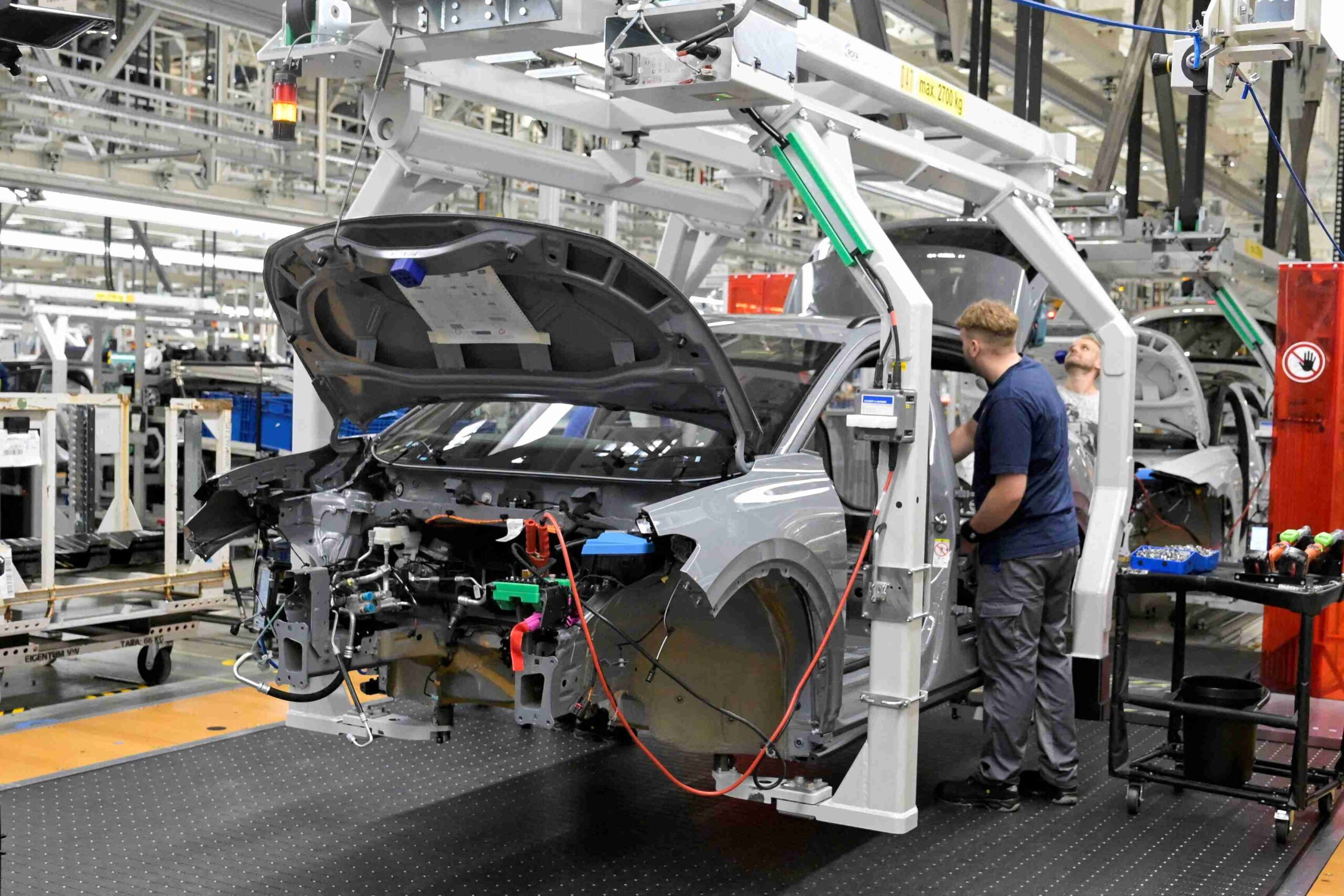
VW AG’s costs are particularly high because it includes staff carrying out administrative functions for the whole Volkswagen Group like sales, management, and technical development, often commanding higher salaries.
Volkswagen has announced tens of thousands of job cuts in Germany in recent years, including a pact with unions struck by previous CEO Herbert Diess to slash 23,000 jobs at the VW brand by 2025.
But the transition to electric, software-driven cars and tighter regulations mean it has also hired many workers in areas like software and administration.
The number of white-collar workers at VW AG is reaching a similar level to blue-collar workers, a source with knowledge of the matter said.
An internal document seen by Reuters showed that while the number of factory workers employed at VW AG fell by over 8,000 between June 2019 and September 2024, the number of administrative staff rose by around 4,000.
Volkswagen declined to comment on the figures.
($1 = 0.9451 euros)
(Reporting by Victoria Waldersee)