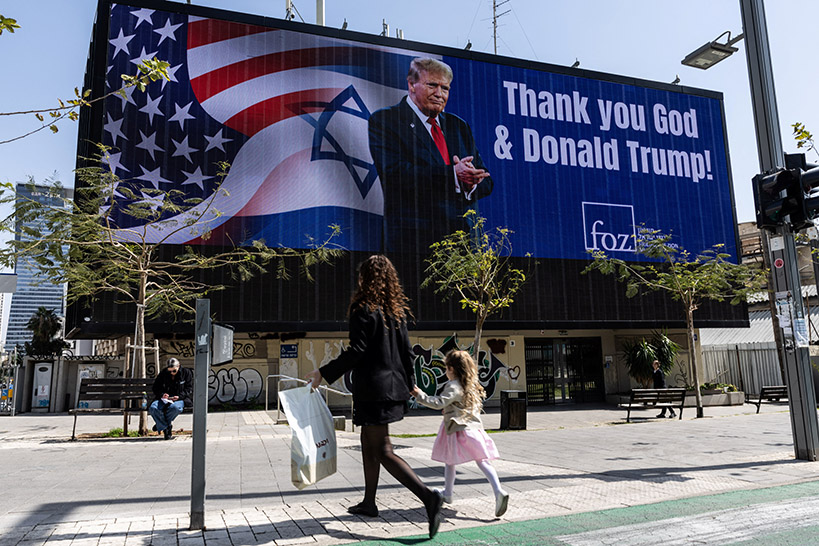
President Donald Trump is using Christian rhetoric to rally core supporters behind the increasingly unpopular war with Iran, religious and political experts say – a message amplified from pulpits by evangelical leaders who cast it as a struggle between good and evil.
Trump, who announced a two-week ceasefire on Tuesday, has struggled to persuade Americans to back the war, which has triggered a surge in energy prices, killed American servicemen and Iranians, and further eroded his standing among voters.
In recent days, he has repeatedly turned to Christian language, calling the rescue of a downed U.S. airman in Iran an “Easter miracle” and suggesting the U.S.-Israeli strikes have God’s blessing. Defense Secretary Pete Hegseth has gone further, citing scripture to justify the use of “overwhelming violence” against enemies he said “deserve no mercy.”
That message has been echoed by conservative Christian leaders – from those close to Trump like Robert Jeffress, an influential Texas pastor, to small-town preachers. They have emphasized the biblical significance of the modern state of Israel, which many evangelicals associate with a prophecy about the Second Coming of Jesus Christ.
EVANGELICALS SEE IRAN WAR AS GOOD VS EVIL
Jackson Lahmeyer, an evangelical pastor and Trump supporter who is running for the U.S. Congress, said in an interview he has told his Tulsa, Oklahoma, congregation in some Sunday sermons that wars are typically battles between good and evil and that Iran was no exception.
“Evil people exist, and if you don’t deal with them, they’ll deal with you,” he said. “Good and evil, that’s the story of the Bible. The good news is that at the end good always wins.”
White evangelicals are among Trump’s strongest supporters: more than 80% voted for him in 2024, according to exit polls, and surveys have shown they account for about one-third of his support.
This political reality is a major reason why Trump and members of his cabinet are increasingly leaning into religious framing of the conflict, several political and religious experts said.
“Look at Mr. Trump’s standing in the polls and recognize he only has a little more than a third of the public on his side. A big part of that constituency is made up of white evangelical Christians,” said Jim Guth, a political science professor at Furman University in South Carolina who studies religion in U.S. politics.
The White House did not respond to questions about Trump’s use of Christian rhetoric but spokeswoman Taylor Rogers said in a statement that the president had taken bold action “to eliminate the threat of this terrorist regime, which will protect the American people for generations to come.”
To be sure, U.S. presidents have throughout history invoked the Christian faith in times of war. But the experts interviewed said the Trump administration’s use of stark, unequivocal language to frame and justify violence in explicitly religious terms sets it apart.
“It’s the same language as the crusades of the Middle Ages. You know, we must stop the infidel, we must defeat the wicked,” said John Fea, a history professor at Messiah University who has written extensively about evangelicals and politics. “We’ve never seen anything like this in American history.”
The overt religious messaging has drawn criticism from some Democrats and left-leaning Christian leaders, who see it as a misguided use of faith to justify an unpopular five-week-old war that has left 13 U.S. service members and thousands of Iranians dead.
Addressing tens of thousands in St. Peter’s Square on Palm Sunday, which opens Holy Week ahead of Easter for 1.4 billion Catholics, Pope Leo called the conflict “atrocious” and said the name of Jesus should never be invoked to propagate a war.
Doug Pagitt, a progressive evangelical pastor, said he believes the administration was deploying a “very specific Christian narrative” to keep evangelicals onside and Trump’s Make America Great Again (MAGA) coalition intact.
“What they are saying is Trump is on God’s side. You can rest easy at night,” he said. “Because without the Christian coalition, the MAGA support base gets very fractured.”
According to a Reuters/Ipsos poll published last week, 60% of respondents opposed U.S. military strikes on Iran. The survey highlighted a deep partisan divide, with 74% of Republicans backing the war versus only 22% of Democrats.
(Reporting by Tim Reid)