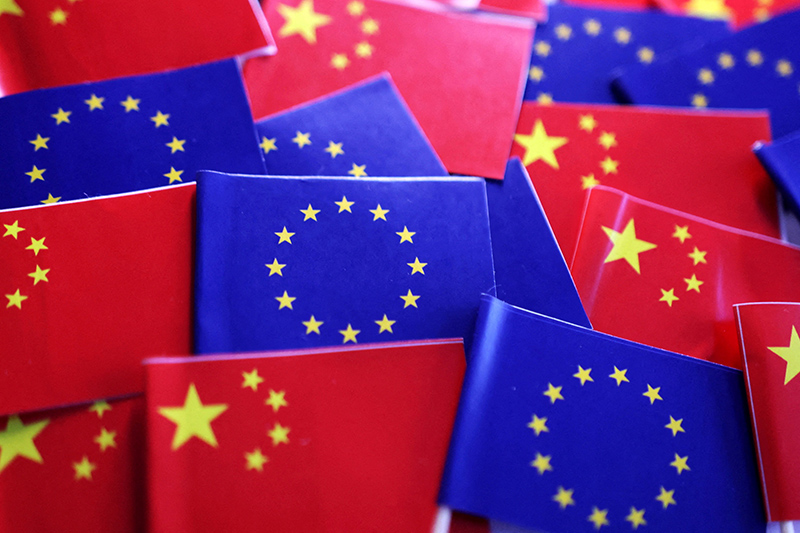
The European Commission unveiled plans on Wednesday to boost the competitiveness of the EU’s manufacturing sector during its drive to decarbonise and avoid reliance on cheap Chinese imports by setting local content requirements.
The intensely debated Industrial Accelerator Act (IAA) will set low-carbon and ‘Made in EU’ requirements for public procurement of, or subsidies for, making aluminium, cement and steel, and technologies including wind turbines, electrolysers or electric vehicles.
The IAA aims to ensure that by 2035 manufacturing represents 20% of the European Union’s national output, from 14% today, stemming a potential loss of 600,000 jobs in the automotive sector over the next five to 10 years and preserving or creating some 150,000 jobs in other sectors. Together, the sectors covered by the IAA represent some 15% of EU manufacturing.
“If we do nothing, then it’s quite clear that very soon, 100% of clean tech technology will be produced in China…It’s quite possible that our cement, steel industries will be offshored completely in the next few years,” Commission Executive Vice-President Stephane Sejourne told a news conference.
Critics say the IAA could prompt trading partners to close their doors.
Proponents point out that rivals such as the United States, China, Brazil and India already have rules on local content in place and that similar requirements could help fill the EU’s massive investment gap.
The EU law aims to use the huge financial firepower of its member countries’ public procurement – worth more than 2 trillion euros ($2.37 trillion) or 14% of EU economic output – to shore up struggling domestic industries and push into newer growing sectors.
DIVIDED VIEWS ON LOCAL CONTENT
The Commission has delayed the proposal numerous times due to disagreements about its content, with changes made even as late as this week. A key point of contention is which non-EU countries will be considered “trusted partners”, exports from which will be treated as equivalent to EU products in meeting the locally-made requirements.
The EU executive has drawn up lists of partners, including Britain, Canada and the U.S., with which it has free trade agreements or which are parties to the World Trade Organization’s Government Procurement Agreement. China is not one of the countries.
The Commission will assess whether the partners offer EU companies reciprocal access to their markets and then cut the lists down for those that do not. Provisions of the Buy American Act or the Buy Canadian Policy could count against those countries.
“Many of our partners exercise national preferences. We therefore expect to be integrated into their markets before they can be integrated into ours. We will exclude…those who do not play by the rules or who pose a risk to our economic security,” Sejourne said.
The European Parliament and EU governments will negotiate the final text – meaning further changes are likely.
France believes this could be limited to the EU27 and EU single market members Norway, Iceland and Liechtenstein, which are automatically included. Some EU countries such as Germany advocate a broader range of countries including Britain.
Bank Jefferies said EU carmakers continued to have high exposure to China for components, particularly batteries, and aggressive local-content rules risked raising costs, undermining competitiveness and threatening EU CO2 emission reduction targets. The IAA does phase in tighter rules over three years.
The European Association of Automotive Suppliers CLEPA said the act provided a crucial foundation for safeguarding European manufacturing and employment, while cautioning that the EU must very carefully assess which countries should be trusted partners.
The IAA proposal also includes rules on foreign direct investment in the bloc, specifically for investments of more than 100 million euros from countries that have over 40% of global production, which in most cases would be China. The bloc wants to avoid Chinese companies assembling products in Europe using imported components, with minimal European employees.
Under the IAA, investors would need to meet some conditions, including having EU workers make up at least 50% of their staff, limiting foreign ownership to 49% and offering transfer of technology with agreements about licensing and access to know-how.
($1 = 0.8655 euros)
(Additional reporting by Alex Chituc)