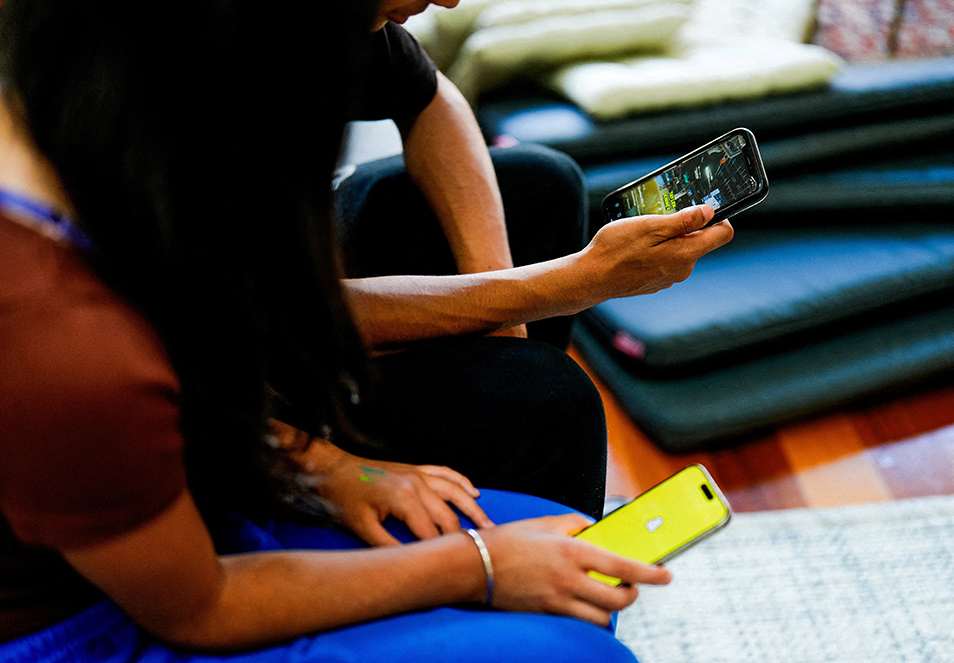
When 13-year-old Jasmine Elkin tried out the age-checking software Australia might use to ban children and teenagers from social media, she was surprised some products could identify a person’s age to the month – but she still doubts it will work.
“People are always going to find a way to get past it,” said the Perth schoolgirl who trialled five photo-based age estimation products with about 30 other students in May. “They can get their brother or sister to take a photo. There’s nothing really that you can do about it.”
Elkin’s view echoes one of the main concerns of child protection advocates, tech firms and even the trial organisers about the technology Australia hopes will enable the world’s first national social media ban for under-16s: the software works, they say, but young people will find a way around it.
From December, social media companies like Meta’s Facebook and Instagram, Snapchat and TikTok will face a fine of as much as A$49.5 million ($32.17 million) if they fail to take what the law calls “reasonable steps” to block younger users in an effort to protect their mental and physical health.
The platforms say users need to be at least 13 years old to sign up for an account.
How well the ban works could reverberate across some of the world’s largest companies and the governments seeking to contain them: already Britain, France and Singapore are making efforts to keep children and teens off social media, while U.S. states including Florida are challenging free speech laws by pushing for a ban.
Even the law’s opponents are likely to be watching closely: X owner Elon Musk, who has been advising U.S. President Donald Trump and is a vocal opponent of platform moderation and regulation, has criticised the measure and called the regulator overseeing it a “censorship commissar”.
“Everybody is looking at Australia,” said Colm Gannon, CEO of the International Centre for Missing and Exploited Children Australia, a member of the trial’s stakeholder adviser group. “Australia should be really focusing on robust technology, robust testing and making sure the scope of the actual project is in line with the needs that they’re trying to address.”
The organisers of the trial, which ended this month, say it was designed to determine whether the software worked as promised, and that nearly 60 products were pitched.
But it also underlined the teenagers’ tech skills – testers were so fast completing their assignments, organisers doubled the number of products they tested and halved session times as the project progressed.
“It hasn’t been our intention to pull apart the software, rip the guts out and work out every different way that you could circumvent it,” said Andrew Hammond, general manager at tech contractor KJR, which ran the trial.
They will present an overview of the findings on June 20 and deliver a detailed report to the government by the end of next month.
That will inform the eSafety Commissioner’s advice to the government, which cited risks from cyberbullying, harmful depictions of body image and misogynist content in pushing forward with the legislation.
“We know that social media age restrictions will not be the end-all be-all solution for harms experienced by young people online, but it’s a step in the right direction to keep our kids safer,” said a spokesperson for Communications Minister Anika Wells.
WHAT ABOUT THE TEENS?
For some of the young Australians who participated, the trial was a glimpse into a world six months in the future where, according to the law, they will no longer be allowed to use a platform they have come to rely on for daily communication.
“I use it a lot, but I can still live without it,” said Canberra school student Charlie Price, 14, who trialled four software options in a room with about 60 peers and had his age guessed accurately (someone in his testing group was wrongly assessed at over 20).
“I know people that will get really shocked and upset,” added Price, who uses Snapchat, Instagram and messaging platform Discord and plans to collect phone numbers of his online associates before December. Like Elkin, he said he thought some teenagers might try to get around the block.
Emanuel Casa, 15, who was in the same group, said the test subjects tried to check the products for ease and accuracy, but “no one tried to challenge it necessarily, like no one tried to trick it.”
Hammond said software that revolved around a user submitting a selfie – sometimes with different facial expressions – proved the fastest and most accurate way to identify teenagers.
Products involving credit card details proved impractical since few young teens had their own cards, while those that required a person to hold up their hand in various positions gave too broad an age estimate for people near the 16 cutoff, he added.
No further trials have been scheduled, but Hammond said the government would need to decide on the level of software reliability it was prepared to accept. Most of the young testers had their ages guessed correctly most of the time, but a peer of Elkin, the 13-year-old, was placed at 42 by one product, she said.
“There is no measure at the moment as to what ‘good’ is. Do they need to be 70% effective or 80% effective or 100% effective?” said Hammond. “The government so far hasn’t indicated that they’re going to mandate a particular solution.”
Nathanael Edwards, principal of Radiant Life College, a Queensland high school where 35 students along with a few parents and teachers participated, said his group tested a basic age-gating product where a person typed in their birthday.
Some did as asked, while others faked a birthday to age themselves up – although not always successfully.
“I think the mathematics caught a couple of kids out,” he said.
(Reporting by Byron Kaye)