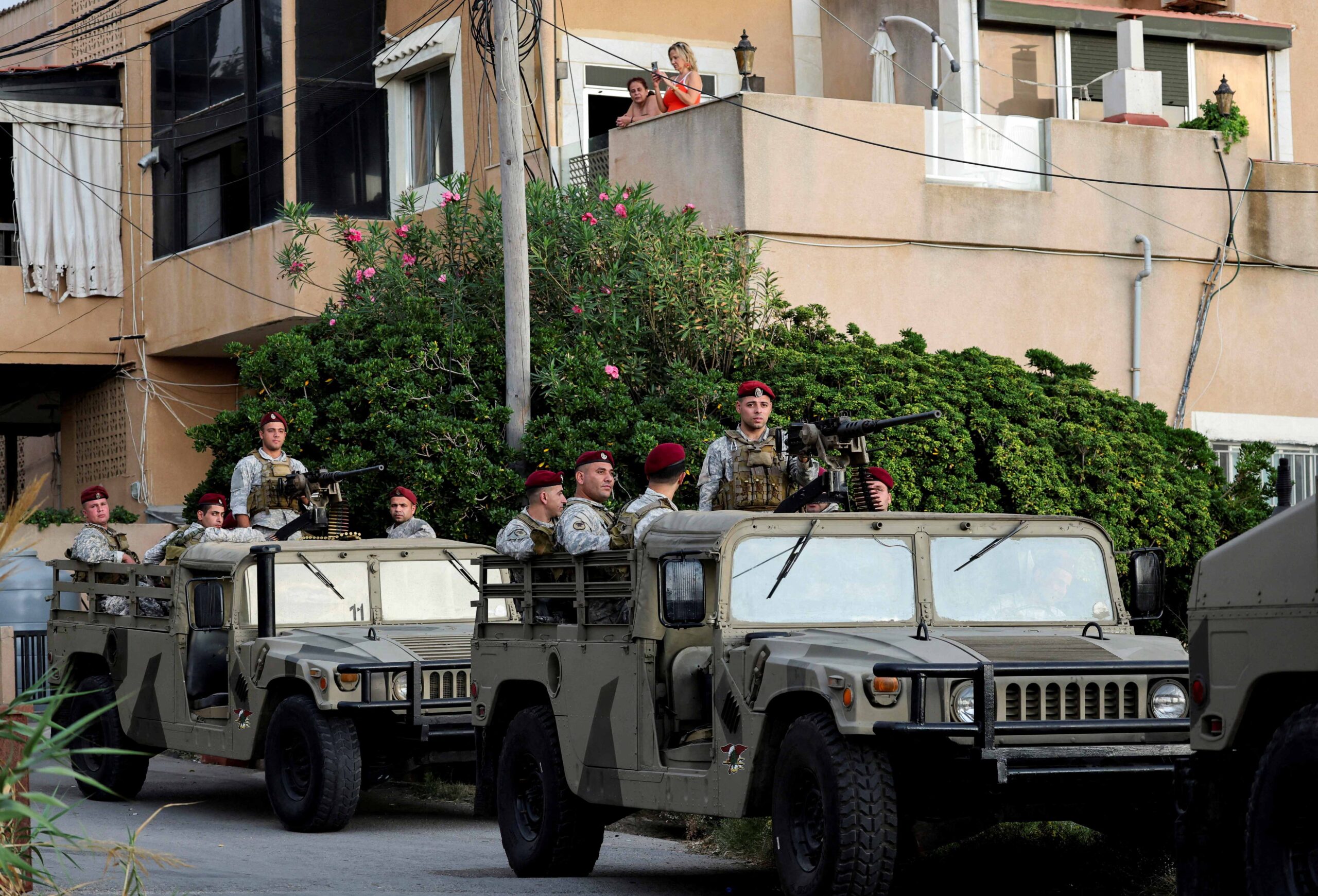
Intensifying efforts for a truce in Lebanon have brought into focus the role of the country’s army, which would be expected to keep the south free of Hezbollah weapons but is neither willing nor able to confront the Iran-backed group, seven sources said.
Hezbollah, though weakened by Israel’s year-long offensive, has long been stronger militarily than the Lebanese Armed Forces, which have stayed on the sidelines of the conflict even after Israel sent ground forces into south Lebanon on Oct. 1.
While the army will likely be required to deploy thousands of troops to the south after any ceasefire deal, it will need Hezbollah’s nod to do so and will avoid confrontations that could trigger internal strife, said the sources – three people close to the army and four diplomats, including from donor countries.
“The Lebanese army is in a situation that is sensitive and difficult. It cannot practice normal missions like the armies of other countries because there is another military force in the country,” said retired Lebanese brigadier general Hassan Jouni, referring to Hezbollah, which enjoys a semi-formal military status as a resistance force.
This week, both the Lebanese government and Hezbollah agreed to a U.S. truce proposal, a senior Lebanese official told Reporters, while cautioning Lebanon still had “comments” on the draft. Hezbollah’s approval is needed for any ceasefire to take effect, given its arsenal and sway over the Lebanese state.
A second official said exactly how the army would be deployed to the south was still under discussion.
The United States is keen to see the army confront Hezbollah more directly and shared that view with Lebanese officials, said two Western diplomats and one of the sources close to the army.
But Hezbollah’s military strength, its shares of Lebanon’s cabinet and parliament, and the proportion of army troops who are Shi’ite Muslim, means such a move would risk internal conflict, they said.
Scenes of the army “storming into houses looking for Hezbollah weapons” would lead to a civil war, one of the diplomats said, arguing that the army could instead work alongside U.N. peacekeeping troops to patrol the south without confronting Hezbollah directly.
Neither the army, Hezbollah or Israel’s military responded to questions for this story.
Last week, Hezbollah spokesman Mohammad Afif told reporters at a press conference that Hezbollah’s relationship with the army remained “strong.”
“You will not be able to sever the connection between the army and the resistance (Hezbollah),” he said, addressing those he said were trying to nudge the army to take on the group. Afif was killed in an Israeli strike on Beirut on Sunday.
The White House declined to comment for this story. Asked by Reporters about the role of Lebanon’s military, the U.S. State Department said it could not comment on “ongoing, private negotiations”.
Lebanese, Israeli and U.S. officials all agree that the cornerstone of a long-lasting truce lies in better implementing United Nations Security Council Resolution 1701, which ended the last round of conflict between Hezbollah and Israel in 2006.
Resolution 1701 says southern Lebanon should be free of weapons that do not belong to the state, and foresees as many as 15,000 Lebanese troops deployed to the south. It was never fully implemented by either side and Hezbollah was able to arm itself and build up fortifications in the south after 2006.
UNUSED WATCHTOWERS
For months, watchtowers donated by Britain for the army to install in the south have gathered dust in a warehouse near Beirut, awaiting a truce, while diplomats negotiate how they could be erected in a way that would antagonize neither Israel nor Hezbollah, two diplomats and a source familiar with the situation said.
The plight of the watchtowers highlights some of the challenges the army will face with any deployment to the southern border.
The army has long avoided fighting Hezbollah, standing aside when the Shi’ite group and its allies took over Beirut in 2008.
Lebanese troops have also been careful not to clash with Israel, withdrawing from the border as Israeli forces prepared to invade in October. The army has held fire even when Israel has struck them directly, killing 36 Lebanese soldiers so far.
The army’s reliance on foreign funding, especially hundreds of millions of dollars from Washington, further complicates its predicament.
Last year, Washington began disbursing cash to fortify troop salaries slashed by Lebanon’s financial crisis after army canteens stopped serving meat and the military resorted to offering sightseeing tours in its helicopters to raise cash.
Two of the sources familiar with the army’s thinking said the risk of losing U.S. support was a major concern for army chief Joseph Aoun, as was keeping the army unified to deploy once a truce is reached.
“Their priority now is to remain intact for the day after,” one of them said.
In response to questions about the army’s role in Lebanon, Karoline Leavitt, spokeswoman for the transition team of U.S. President-elect Donald Trump, who takes office in January, said he would act to restore “peace through strength around the world” when he returns to the White House.
Trump has nominated staunchly pro-Israel figures to influential diplomatic posts, including real estate developer Steve Witkoff as his Middle East envoy. Witkoff did not reply to questions.
One of the sources close to the army said it had no choice but to wait until the conflict ends to assess the state of Hezbollah’s military strength before its own role becomes clear.
Founded in 1945, the army’s troops are split almost evenly between Sunni Muslims, Shi’ite Muslims and Christians, making it a longstanding symbol of national unity.
Consisting of approximately 40,000 active personnel, the army sees itself primarily as the guarantor of civil peace, a Lebanese security source and the two sources familiar with the army’s thinking said, particularly as tensions rise with hundreds of thousands of displaced Shi’ites seeking refuge in primarily Christian, Sunni and Druze areas in the current war.
It has also fought hardline Sunni groups – in Palestinian camps in 2007 and along Lebanon’s border with Syria in 2017.
The army fractured along sectarian lines in 1976, in the early years of Lebanon’s 15-year civil war, catalyzing Lebanon’s descent into militia rule, which ended in 1990 with armed groups relinquishing their weapons – except Hezbollah.
AID DELAYED
Some international aid to the army has already been held up, three more diplomats said.
World powers pledged $200 million to the force in Paris last month on the expectation that it would go towards recruiting new troops, but differences have emerged.
U.S. officials have sought to withhold funds until a ceasefire is agreed to pressure Lebanon to make concessions, while Lebanon says it needs to recruit first to be able to implement a ceasefire, a European diplomat, a senior diplomat and a U.N. source told Reporters.
A U.S. official disputed that Washington was using aid as leverage. The State Department said Washington was committed to supporting the Lebanese state and its sovereign institutions. The White House declined to comment.
However, there is precedent. U.S. lawmakers in 2010 briefly blocked funding for Lebanon’s military after a deadly border clash between Lebanon and Israel. In late September, a Republican U.S. lawmaker introduced a bill aiming to halt all financial aid, including for salaries, to the army until the Lebanese state barred Hezbollah as a political party.
Since 2008, ministerial statements have given Hezbollah legitimacy as an armed entity in the country alongside the military, without clearly detailing limits on its role.
“The situation needs internal political understandings to determine the role of Hezbollah in the security and military sphere in Lebanon,” said Jouni, the retired brigadier general.
(Reporting by Maya Gebeily)