Seeping into just about every conversation at this week’s meeting of the world’s top central bankers was one big unknown: how artificial intelligence will impact the world economy and therefore their mandate to ensure financial stability.
The consensus of those discussions at the ECB’s annual conference in the windy hills of Portugal was that AI has the power to disrupt everything and create problems they can’t even imagine right now: in financial and labour markets, in bank lending, for security, and even for power demand.
“If AI overdelivers, it will impact financial stability. If AI underdelivers, it will impact financial stability,” Torsten Slok at Apollo Global Management told the arbiters of interest rates around the world at one of the main panel sessions in the resort of Sintra.
AI was such an overarching theme in Sintra that the topic found its way into every discussion, from immigration and supervision to climate.
It even outdid new Federal Reserve Chairman Kevin Warsh, making his debut meeting with fellow central bankers, as the clear star of the three-day show.
While AI can improve every corner of life, the fear of many speakers was that it can also disrupt it, at times illegally, and that finance officials have few if any tools to stop it.
“This is the biggest time of consequence to each of our economies, I think, in our lifetime,” Warsh said about the AI revolution.
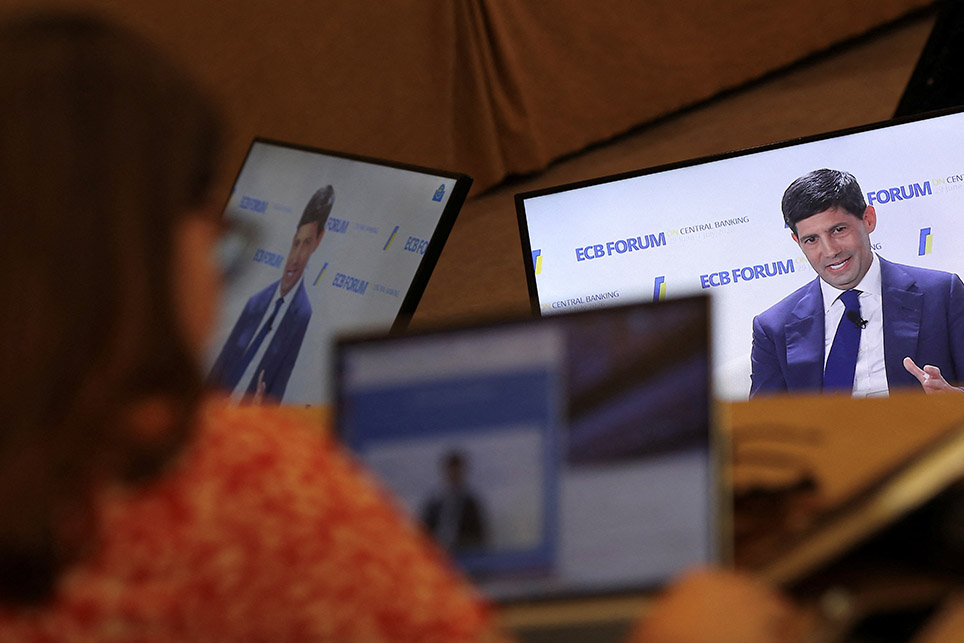
“Who knew when the internet was born that the internet was going to create a million and a half jobs as Uber drivers? We are in the first to second inning of this revolution,” he told the ECB Forum.
INFLATING BUBBLES
In the case of trading, automation is already running most functions. But an AI-driven boost could inflate bubbles at warp speed, then crash them, profiting both on the way up and on the way down in a type of collusion that is now illegal.
“Something that is even more advanced and potentially more disturbing, is the ability of these algorithms to coordinate on a manipulative path of prices,” University of Pennsylvania professor Itay Goldstein said.
“These algorithms indeed manage to achieve this kind of manipulation, creating bubbles leading to crashes, and this, I think, has more significant implications for financial stability,” he added.
One potential bubble AI is already creating is that of AI stocks, in part generated by massive capital spending on the building blocks of AI, which Slok estimated had added one percentage point to U.S. GDP alone.
While valuations have retreated in recent weeks, experts liken the rapid rise in pricing to some of the biggest asset price busts in history, like the British railway mania of the 1840s, the roaring 1920s or the dotcom boom.
“The scale and pace of the current AI investment boom accompanied by expectations of large productivity payoffs bear resemblance to these precedents, highlighting potential downside risks in the near term,” the Bank for International Settlements said in a report.
SUPERVISING THE UNEXPLAINABLE
AI will also help — but complicate — lending. Banks will be able to do more sophisticated credit analysis and extend funding to borrowers now outside their traditional sphere.
But supervising this will be a nightmare.
“How do supervisors assess those kind of agentic loan decisions? They are a little bit black box. There’s potentially a lack of explainability, and I think that is a key supervisory challenge,” Tobias Adrian, a senior IMF official, said.
AI will also drive a wedge between richer and poorer firms and countries.
Defending against malicious threats will become even more expensive, and otherwise viable firms will struggle to protect themselves.
“When you think of the most outrageous attacks, they’re often attacking the weakest link,” Adrian said.
Sarah Breeden, a Bank of England Deputy Governor, said a potential solution may be to create some sort of insurance scheme, likening it to deposit insurance in case of bank failures.
“In a cyber context, do we need systems that allow one institution to pick up another’s basic functions during disruption?” she said.
But the ultimate risk is that the excessive success of AI could fundamentally undermine the global economy.
If AI delivers on some of the most optimistic efficiency expectations, machines could replace humans en masse, leading to large unemployment. This then reduces disposable incomes and pushes the economy into recession, undermining the case for the investment.
But if AI is less successful, then the massive investment into the sector fails to deliver the expected returns.
“The internet proved to be better than anybody imagined, created whole new businesses, but we still got the dotcom bubble,” Bank of Canada Governor Tiff Macklem said. “It doesn’t mean there can’t be a period where the market gets ahead of itself, and, and you see an entrenchment.”
(Reporting by Balazs Koranyi)