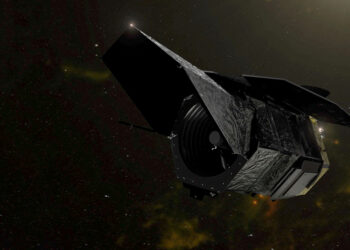
NASA launched a spacecraft from Florida on Monday on a mission to examine whether Jupiter’s moon Europa has conditions suitable to support life, with a focus on the large subsurface ocean believed to be lurking beneath its thick outer shell of ice.
The U.S. space agency’s Europa Clipper spacecraft blasted off from the Kennedy Space Center in Cape Canaveral on a SpaceX Falcon Heavy rocket under sunny skies. The robotic solar-powered probe is due to enter orbit around Jupiter in 2030 after journeying about 1.8 billion miles (2.9 billion km) in 5-1/2 years. The launch had been planned for last week but was put off because of Hurricane Milton.
It is the largest spacecraft NASA has built for a planetary mission, at about 100 feet (30.5 meters) long and about 58 feet (17.6 meters) wide with its antennas and solar arrays fully deployed – bigger than a basketball court – while weighing approximately 13,000 pounds (6,000 kg).
Even though Europa, the fourth-largest of Jupiter’s 95 officially recognized moons, is just a quarter of Earth’s diameter, its vast global ocean of salty liquid water may contain twice the water in Earth’s oceans. Earth’s oceans are thought to have been the birthplace for life on our planet.
Europa, whose diameter of roughly 1,940 miles (3,100 km) is approximately 90% that of our moon, has been viewed as a potential habitat for life beyond Earth in our solar system. Its icy shell is believed to be 10-15 miles (15-25 km) thick, sitting atop an ocean 40-100 miles (60-150 km) deep.
NASA Associate Administrator Jim Free told a prelaunch briefing on Sunday that Europa boasts one of the most promising environments for potential habitability in our solar system, beyond Earth, though he noted that this mission will not be a search for any actual living organisms.
“What we discover on Europa,” Free said, “will have profound implications for the study of astrobiology and how we view our place in the universe.”
“Scientists believe Europa has suitable conditions below its icy surface to support life. Its conditions are water, energy, chemistry and stability,” said Sandra Connelly, deputy associate administrator of NASA’s science mission directorate.
Among the mission objectives are measuring the internal ocean and the layer of ice above it, mapping the moon’s surface composition, and hunting for plumes of water vapor that may be venting from Europa’s icy crust. The plan is for Europa Clipper starting in 2031 to conduct 49 close flybys of Europa over a span of three years, coming as close as 16 miles (25 kilometers) to the moon’s surface.
Europa Clipper will be operating in an intense radiation environment around Jupiter, our solar system’s biggest planet.
Jupiter is enveloped by a magnetic field about 20,000 times stronger than Earth’s. This magnetic field spins, capturing and accelerating charged particles and creating radiation that could harm spacecraft. NASA fashioned a vault made of titanium and aluminum inside the Europa Clipper to protect its sensitive electronics from this radiation.
“One of the Europa Clipper mission’s main challenges is delivering a spacecraft hardy enough to withstand the pummeling of radiation from Jupiter but also sensitive enough to gather the measurements needed to investigate Europa’s environment,” Connelly said.
NASA said Europa Clipper is loaded with more than 6,060 pounds (2,750 kg) of propellant to get it to Jupiter. For the launch, the spacecraft was placed inside the protective nose cone atop the rocket.
The spacecraft will not take a straight path to Jupiter. Instead, it is due to fly by Mars, then back by Earth, using the gravity of each planet to increase its momentum like a slingshot. Its expansive solar arrays, which were folded up for the launch, will gather sunlight for powering the spacecraft’s nine scientific instruments as well as its electronics and other subsystems.
(Reporting by Will Dunham )