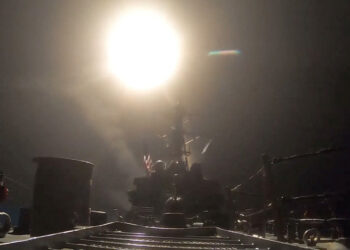
President Donald Trump has ramped up U.S. air strikes on Iran and threatened broader escalation, but there is little sign that a military strategy that has already failed to extract concessions from Tehran will succeed this time.
With the collapse of an interim ceasefire deal reached a month ago, Trump finds himself in a bind as he seeks to break Iran’s grip on the vital Strait of Hormuz and force Tehran to accept his demands.
While the two sides have so far avoided a return to full-scale conflict, hopes of finding an off-ramp anytime soon have faded in a crisis that has again driven up global oil prices and sent shockwaves through financial markets.
A wave of tit-for-tat attacks continued into a sixth day on Thursday while Iran signaled it could prod its Houthi allies in Yemen to close another key oil-shipping strait — the Bab al-Mandeb at the mouth of the Red Sea – if Washington hits Iran’s power infrastructure as Trump has threatened.
Signaling increased frustration, Trump has discussed with aides, and in some cases spoken publicly, about possibly expanding targets to include energy plants and bridges, sending ground forces to seize Iran’s Kharg Island oil hub and bombing a deep-underground nuclear-linked site known as Pickaxe Mountain.
Some of these options may be unrealistic due to the high risks and potential for domestic and geopolitical blowback. He has issued similar threats before only to back down.
But most analysts agree that a major U.S. escalation – short of a dangerous and politically untenable ground invasion to oust Iran’s rulers – would have little chance of being any more effective in forcing Iran to change course than earlier phases of the 4-1/2-month-old war in which U.S.-Israeli strikes killed senior leaders and heavily damaged military capabilities.
“There’s no reason to believe that this latest set of attacks or whatever the president has in mind will compel the Iranians to change their thinking,” said Jonathan Panikoff, a former deputy U.S. intelligence officer for the Middle East now at the Atlantic Council think tank. “It’s perhaps more likely to harden their position.”
A senior Trump administration official, responding to Reporters’ questions, said the president’s preference is for diplomacy but “the only language that Iran understands is military might” and the U.S. will continue to hold it accountable for “terrorist acts” in the strait.
INTERIM DEAL UNRAVELS
The unraveling of the deal comes as Trump faces pressure to end a war that has killed thousands, mostly in Iran and Lebanon, inflicted economic pain at home and driven down his approval ratings ahead of November’s midterm elections.
Negotiations meant to turn the interim accord into a permanent peace deal have stalled, though there have been hints of diplomatic movement. Trump hailed what he described as the release of a U.S. citizen detained in Iran, though Iran’s judiciary denied any prisoner had been freed or exchanged.
Trump may be hoping he can bomb Iran back to the negotiating table over its nuclear program, which he set as his main war objective. But at the root of the latest hostilities are differing interpretations of what the preliminary deal means for control of the strait, where Iran showed during the war it could choke off one-fifth of the world’s oil shipments.
Iran sees itself having a role in managing the waterway, possibly charging fees or tolls, while the U.S. and its Gulf allies insist on a return to free passage. Most experts see little indication Tehran will make concessions Trump is seeking.
Tehran’s resumption of attacks on shipping in recent days – which the White House on Thursday called a violation of the interim accord – triggered the latest U.S. response, including reinstatement of a blockade of Iranian ports.
Washington also revoked a waiver allowing Iran to sell oil internationally, undoing one of its gains under the interim agreement.
Three U.S. officials told Reporters the wave of U.S. strikes could serve as “shaping operations”, giving Trump more options by targeting Iranian military capabilities that the U.S. would want destroyed before taking bigger steps.
Iran has responded by signaling its readiness to widen the war, warning that it could hit the civilian facilities of U.S. Gulf allies if Trump escalates further. It retains significant missile and drone arsenals.
RED SEA ROUTE THREATENED
Tehran has also asked Yemen’s Houthis to be prepared to close the Red Sea oil route if the United States strikes Iranian power infrastructure, three sources told Reporters, posing a potent new threat to global energy supplies, particularly since some shipments have been diverted to the Red Sea.
But Mark Dubowitz, head of the Foundation for Defense of Democracies, a hardline anti-Iran think tank in Washington, wrote on X that Tehran was “playing the Hormuz card out of desperation” and such moves would hasten global efforts to build new pipelines and shipping corridors to erode its “ability to extort the world.”
Some analysts suggested that Trump, who campaigned for a second term on promises to avoid foreign interventions and focus on Americans’ economic concerns, may commit some of the same mistakes he made when he launched the war on February 28.
He did so with little explanation of his reasons or a clear exit strategy.
But the senior U.S. administration official pushed back, insisting it was U.S. military and economic pressure that brought Iran to the table to negotiate the memorandum of understanding, which has since lapsed into renewed hostilities.
“No matter how much pressure the administration applies, or how many new threats it issues, Iran’s leadership is unlikely to capitulate,” Danny Citrinowicz, an Iran researcher at Israel’s Institute for National Security Studies and a former Israeli military intelligence officer, said on X.
“If President Trump continues expanding the target set, Tehran is likely to respond in kind,” he wrote.
(Reporting By Matt Spetalnick, )