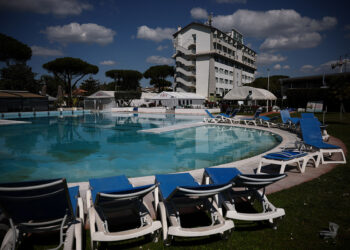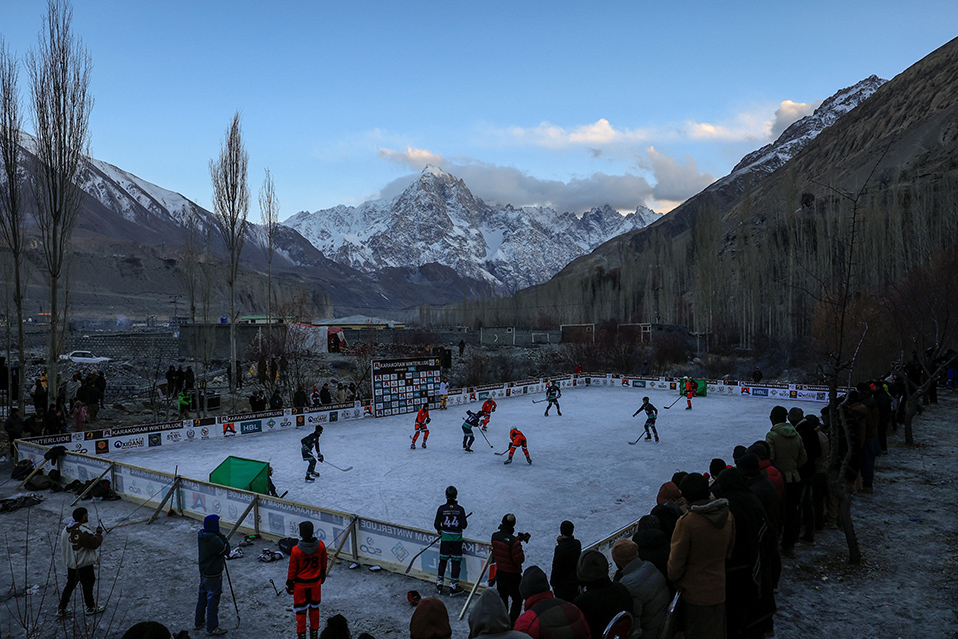
Every winter for decades, the pool in front of Aleena Gul’s house in Pakistan’s Hunza Valley has transformed into an ice rink, framed by jagged Himalayan peaks and the stone walls of Altit Fort.
This year, it did not.
Gul can see the swimming pool that doubles as a hockey arena from her bedroom.
For years, she would wake up at dawn, lace her skates and step straight from her front door onto solid ice.
After four years away at university, she returned eager to play again, but has found herself waiting for winter to arrive.
“There’s a big difference between 2018 and now,” said Gul, 21, captain of her team and among the first women in Hunza to take up the sport. “Winter used to begin in November and everything would freeze. It’s January now and the ice still hasn’t frozen properly.”
Across Pakistan’s northern mountains, winters are arriving later and behaving unpredictably. Cold spells are shorter, freeze–thaw cycles unstable. In the wider Hindu Kush–Himalayan region, scientists report fewer extreme cold events and shorter snow seasons; what locals call a “snow drought,” when snowfall fails to settle.
The change is visible in Hunza. Data compiled by WeatherWalay, a climate analytics platform, shows average winter precipitation has fallen about 30% since the late 2010s, recording four consecutive years below normal. Some recent winters have also been 2–3°C milder, so there is less snow to sustain the ice.
Unlike European resorts with artificial snow, Hunza’s tournament depends entirely on natural ice.
In a valley heavily dependent on tourism, winter sport now hinges on weather that no longer follows old rhythms.
ICE UNDER PRESSURE
For eight seasons, Altit’s pool has hosted the Karakoram Interlude, a community-run tournament that draws teams from across northern Pakistan and extends the tourist season beyond summer.
On good years, the rink glows under floodlights, spectators leaning over stone parapets tea cups in hand, their breath rising in white clouds.
This year, organisers prepared the rink as always, pouring water at night and smoothing the surface by hand to allow temperatures of below –20°C to set the layers.
“We stayed up until 3 a.m. trying to help it freeze,” Gul said. “We’re doing everything we can.”
In 2024, “we started seeing a sudden change in weather patterns like snowfall, freezing levels and overall temperatures,” said Sadiq Saleem, 31, president of the Altit Town Management Society and a founding member of the youth organisation SCARF, which pioneered ice hockey in the valley.
Thin puddles formed where blades scratched the ice. Hairline cracks spread beneath the surface. Organisers pressed their palms to the ice, checking for flex and listening for cracks.
“We worked on this arena for a week,” said Naseer Uddin, 34, co-founder of SCARF. “But when the sun came out strongly, it ruined everything.”
The opening ceremony went ahead under floodlights, but organisers warned the rink was too fragile to support entire teams.
Only captains stepped forward to unveil jerseys beside sponsors, wary of the thinning ice.
The traditional opening night friendly match was cancelled.
CHASING COLD
There was little time to argue with the weather.
Within hours, organisers moved through Altit’s lanes, calling players and knocking on doors. The tournament was moved nearly two hours north to Sost, one of the last towns in Pakistan before the Chinese border, where colder air offered better odds of sufficient ice.
They had done this before.
Two winters ago, when the pool in Altit also failed to freeze, the ice in Sost, about 2,800 metres (9,186 feet) above sea level — roughly 300 to 400 metres higher than Altit — held firm.
This year, that solution faltered too.
For Gul, it felt like chasing a season that kept retreating.
In Sost, the rink lay on an exposed stretch of valley floor near the Khunjerab Pass, beneath steep, wind-cut ridges funnelling cold air down from even higher elevations.
And while the surface was firmer than Altit’s pool, some parts were thin. Players tested it cautiously before committing their weight.
Three matches were scheduled that first day. Only one went ahead.
“When we reached the rink the ice wasn’t in good condition,” Gul said. “Teams still played, but it was very difficult. We’ve never experienced this before.”
Skaters stumbled where the ice had cracked and softened, blades catching unexpectedly.
Each evening, organisers poured water across the rink, hoping the overnight temperatures would help it freeze.
“Our event depends entirely on natural ice,” said Saliha Ibrahim, 21, part of the organising team. “If we can’t improve the surface, we may have to consider changing the venue again.”
WINTER CAN’T PAY THE BILLS
It is not only the players who feel the strain.
Unpredictable winters ripple through cafés, guesthouses and transport operators. Smaller guesthouses without heating struggle as pipes freeze, cutting off water, then thaw and refreeze unpredictably, raising the risk of bursts and costly repairs.
Globally, fewer regions can reliably host winter sports as temperatures rise.
In Hunza, a district of fewer than 100,000 people, residents are confronting that reality without artificial snow or refrigeration systems — and without certainty.
Winter has long been quieter than summer in Hunza, but residents say erratic snowfall, floods and impassable roads deter visitors who come for snow-covered peaks and frozen lakes, just as the Karakoram Interlude had begun drawing travellers from across Pakistan and beyond.
Naseera Khatoon runs Murku Café overlooking the pool in Altit. Her daughter, Arifa, plays ice hockey. In previous years, tournament week meant steady customers, with families lingering long after matches ended over meals of traditional soup and dumplings.
This year, despite the ceremony, her café remained quiet.
“Usually we earn income during the tournament,” she said. “This time, there was very little.”
She remembers winters when snowfall was heavy enough to close schools for months and families stored food in advance of long, cold spells.
“We used to dry vegetables and store groceries because roads would close [in winter],” she said. “Now food is available year-round, but the snow and ice are disappearing.”
Kareem ul Hayat, who oversees the restored 900-year-old Altit Fort, said winter tourism had grown as events like ice hockey drew visitors. In recent winters, he said, numbers had waned.
“In the past, the mountains stayed white,” he said. “Now the snow disappears quickly.”
TITLE ON THIN ICE
Back in Sost, the tournament continued.
Players adjusted their game to the more challenging conditions. Spectators tightened their scarves against the wind.
Yahya Karim, 20, a player from Altit, said the surface was unlike anything the team had trained on.
“I expected better ice conditions, but when I saw the rink I felt a bit sad,” he said. “Many of our players fell. The surface had too many bumps and wasn’t strong.”
They had chased winter north. But even there, the cold remained elusive.
On a scarred, uneven rink, Gul’s team emerged victorious, a title claimed on fragile ice far from home.
(Reporting by Ariba Shahid and Salah Uddin)